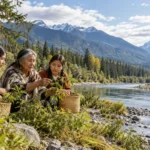
A forest that looks completely wild may actually carry centuries of human care. A meadow might exist because generations regularly burned it.
A productive shoreline may have been reshaped to support shellfish, while mountain terraces can survive because entire communities maintain carefully coordinated water systems.
This is why traditional land management among Native communities is more complex than simply “using natural resources.”
Across different regions, Indigenous Peoples have developed highly localized systems for managing fire, water, soil, plants, wildlife, forests, and coastal environments.
These practices are often based on generations of observation combined with cultural responsibilities, seasonal knowledge, spirituality, and community rules.
There is no single Indigenous land management model. Practices used by Coast Salish communities differ from those of California Native nations, Australian Traditional Owners, or Indigenous farmers in the Philippine Cordilleras.
What many systems share, however, is a long-term approach. Land is not viewed only as something that produces resources today.
Stewardship often involves maintaining relationships that allow people, species, and culturally important places to continue into future generations.
Land Management Is Often About Relationships, Not Just Resources
Modern land management is frequently described through categories such as forestry, agriculture, conservation, or wildlife management.
Traditional Indigenous systems do not always divide the landscape so neatly.
A forest might simultaneously provide medicine, food, hunting habitat, ceremonial materials, stories, and sacred locations. Managing that forest therefore involves much more than maximizing timber or protecting individual species.
UNESCO describes traditional ecological knowledge as knowledge developed by Indigenous and local communities over generations, including understandings of biodiversity, resource management, and ecological relationships.
Cultural responsibilities can be equally important.
Rules about when to gather plants, which places should remain undisturbed, or who is responsible for a particular area may function as practical conservation measures while also expressing cultural values.
This means traditional land stewardship cannot simply be separated from community identity.
The enviroment is both an ecological system and a cultural landscape.
Cultural Burning Can Create Healthier Landscapes
Fire provides one of the clearest examples of Indigenous land management.
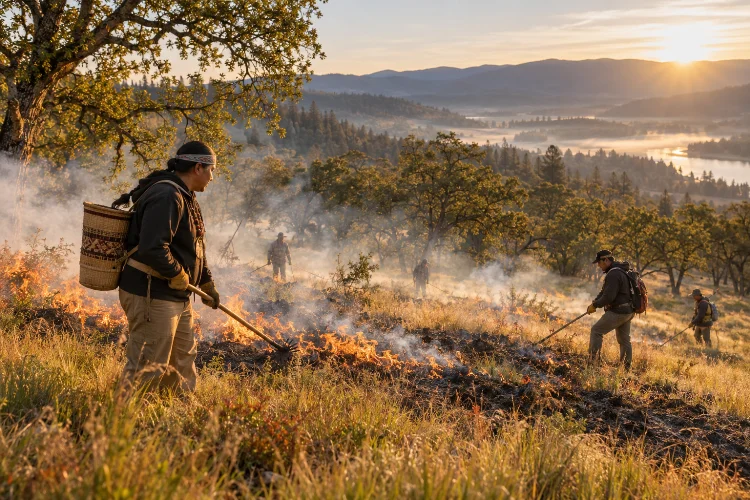
For generations, Native peoples in California deliberately used controlled fire to influence vegetation, promote useful plants, maintain open landscapes, and create habitat for wildlife.
The U.S. National Park Service notes that Indigenous burning helped stimulate plants used for food, medicine, basketry, string, and shelter. Evidence of these practices can still be found in places such as Yosemite Valley and Muir Woods.
These fires were not uncontrolled wildfires.
Cultural burning involves detailed decisions about temperature, wind, fuel moisture, season, location, and ecological purpose.
Australia offers similar examples. In Kakadu National Park, Bininj/Mungguy Traditional Owners use small, cool, patchy fires during appropriate seasons. These burns can encourage diverse habitats and reduce the chance that large, intense fires will spread later in the dry season.
Fire therefore becomes a management tool rather than simply a destructive force.
Importantly, cultural burning is also cultural. It may support foods, ceremonies, hunting practices, important plants, and relationships with Country.
Seasonal Harvesting Helps Prevent Resources From Being Exhausted
Traditional stewardship often depends on knowing when not to harvest.
Plants, animals, fish, and shellfish follow reproductive and seasonal cycles. Taking too much at the wrong time can reduce future populations.
Communities that depend on the same landscapes across generations have strong practical reasons to observe those cycles carefully.
Traditional rules may restrict harvesting during breeding periods, protect particular locations, rotate gathering areas, or encourage people to take only what is needed.
This approach is very different from treating nature as an unlimited supply.
FAO notes that Indigenous Peoples possess extensive knowledge of forest ecology, food-producing species, medicinal resources, and traditional forest and agroforestry practices. Such knowlege has developed alongside changing ecological conditions.
Seasonal management can also support cultural calendars.
The appearance of a plant, migration of an animal, changing tide, or arrival of rain may signal that another activity should begin.
Land management therefore becomes connected with time, language, food, and ceremony.
Coast Salish Clam Gardens Show That Coastlines Can Be Cultivated
Traditional land management does not stop at the shoreline.
For thousands of years, Coast Salish peoples have tended clam gardens along parts of the Pacific Northwest coast.
These systems involve building rock walls near low-tide marks. Sediment accumulates behind the walls, creating broad terraces that provide favorable habitat for clams.
Parks Canada reports that restored clam gardens in the Gulf Islands can support substantially more shellfish than unmodified beaches. Modern restoration projects are being carried out with W̱SÁNEĆ and Hul’q’umi’num communities.
The practice demonstrates something important.
A landscape does not need to look like a modern farm to be actively managed.
People can increase food production while simultaneously caring for habitat through relatively subtle changes to an ecosystem.
Restoring these gardens also restores cultural knowledge.
Community members learn where walls were built, when tides make work possible, how beaches should be maintained, and how shellfish harvesting connects with traditional food systems.
Food production and cultural revitalization become part of the same process.
Indigenous Farming Systems Can Manage Entire Watersheds
Some traditional management systems operate across surprisingly large landscapes.
The rice terraces of the Philippine Cordilleras provide an impressive example.
Indigenous Ifugao communities developed complex terraced landscapes requiring coordinated irrigation, soil conservation, pest management, crop knowledge, and community cooperation.
UNESCO explains that their continued maintenance depends on ancestral land-management traditions, detailed biological knowledge, seasonal planning, and collective responsibility.
Water management is particularly important.
Farmers cannot simply irrigate one field without considering what happens above and below it. Forests, streams, terraces, drainage, and neighboring farms become part of an interconnected system.
This encourages cooperation.
Traditional land managment therefore frequently operates at scales larger than an individual household. Community rules and customary rights help coordinate resources that everyone depends on.
The result is not merely an agricultural technique.
It is a social system built around maintaining the landscape.
Biodiversity Often Benefits From Long-Term Indigenous Stewardship
One of the most persistent misconceptions about conservation is that healthy ecosystems must be places where humans have had little influence.
Many landscapes considered “natural” have actually been shaped by people for generations.
FAO reports that Indigenous Peoples manage roughly 28 percent of the world’s land surface, including significant areas containing ecologically intact forests. It also emphasizes the important role of Indigenous governance and traditional management in protecting biodiversity.
IPBES similarly notes that at least a quarter of global land is traditionally owned, occupied, managed, or used by Indigenous Peoples, and that their governance systems often contribute to maintaining biodiversity and reducing habitat loss.
This does not mean every traditional practice automatically produces perfect conservation outcomes.
Communities, environments, technologies, and pressures change.
The more useful lesson is that human presence and biodiversity protection are not necessarily opposites.
Long-term stewardship can create mosaics of habitats, maintain useful species, protect water sources, and support ecosystem diversity.
Colonization Often Disrupted Traditional Stewardship
Many Indigenous land management systems did not simply disappear because communities voluntarily abandoned them.
Colonization frequently restricted them.
Native peoples were displaced from ancestral territories, customary burning was prohibited, traditional harvesting access was reduced, and outside governments imposed different systems of land ownership and conservation.
California provides a clear example.
California State Parks explains that cultural burning practiced by Native American tribes was heavily restricted during colonization as Indigenous people were removed from their ancestral lands. Today, tribes and state agencies are working together in some areas to restore those practices.
This history matters because ecological consequences can follow cultural disruption.
When regular low-intensity burning stops, vegetation and fuel can accumulate. When communities lose access to food landscapes, knowledge about managing particular species may also become harder to transmit.
Restoring stewardship is therefore not simply about copying an old technique.
It may require restoring access, authority, intergenerational teaching, and Indigenous leadership.
Traditional Knowledge Is Most Effective When Communities Lead
Interest in Indigenous land management has grown as governments face biodiversity loss, severe wildfires, climate change, and degraded ecosystems.
That interest creates opportunities, but it also creates risks.
Traditional knowledge cannot simply be extracted from communities and turned into a technical manual.
A cultural burn, for instance, is more than lighting a low-intensity fire.
Australian environmental authorities emphasize that these practices are specific to individual communities and Country and involve cultural protocols, obligations, ecological understanding, and relationships with ancestors.
The same principle applies to harvesting, farming, fisheries, and water management.
Effective collaboration requires Indigenous communities to participate in decision-making and maintain authority over their own knowledge.
IPBES increasingly treats Indigenous Peoples and local communities as important actors in biodiversity governance rather than merely sources of information.
Respectful land stewardship starts with listening to the people who have maintained relationships with those landscapes across generations.
Traditional Land Management Is Still Changing
Traditional does not mean frozen in the past.
Native communities continue adapting land management to new technologies, climate conditions, invasive species, legal frameworks, and economic realities.
Indigenous rangers may use satellite imagery while applying cultural fire knowledge. Community members restoring clam gardens can combine archaeological research with knowledge from elders.
Farmers maintaining terraces may use modern tools while preserving older water-sharing systems.
This adaptability is one reason these practices have survived.
Traditional ecological knowledge is not simply a collection of ancient instructions.
It is a living process of observation, experimentation, teaching, and adjustment.
Supporting it therefore means giving communities room to keep innovating.
The strongest future for Indigenous stewardship is not a museum version of the past. It is a living comunity having the authority and resources to decide how inherited knowledge should guide present-day landscapes.
Traditional land management among Native communities demonstrates that people can shape ecosystems without treating them simply as resources to exploit.
Cultural burning can renew vegetation and reduce severe fire risk. Seasonal harvesting can protect future resources, clam gardens can increase coastal food production, and complex farming systems can coordinate soil, forests, and water across entire landscapes.
Just as importantly, these practices preserve languages, foods, ceremonies, stories, and relationships with ancestral places.
Protecting Indigenous stewardship therefore requires more than borrowing useful techniques. It means respecting land rights, community leadership, cultural protocols, and the knowledge systems that give those practices meaning.
To understand a landscape more deeply, ask not only what looks natural today, but also who has cared for it – and how that care has shaped the place over generations.