
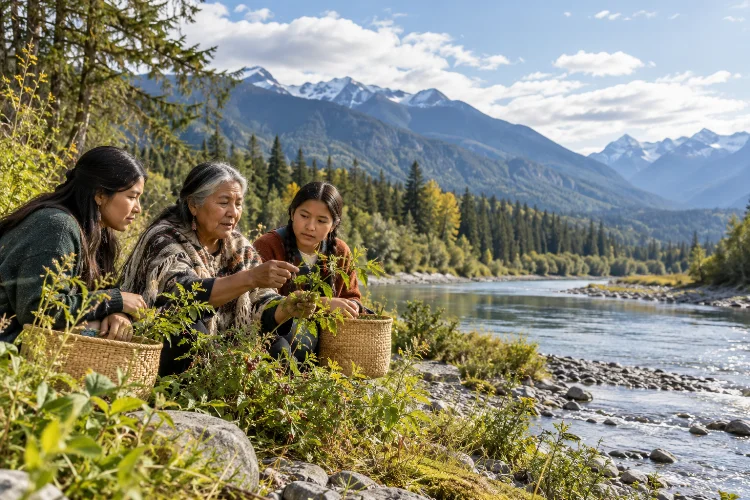
For many Indigenous Peoples, knowing the environment is not simply about identifying plants, predicting weather, or finding food. Ecological knowledge can also carry language, family history, spirituality, law, stories, and responsibilities toward particular places.
That is why Indigenous ecological knowledge and cultural continuity are so closely connected.
Over generations, communities have developed detailed understandings of forests, grasslands, rivers, deserts, mountains, oceans, wildlife, fire, and seasonal change.
This knowledge is often learned through direct participation rather than from a textbook. Children may accompany elders while fishing, gathering plants, herding animals, managing fire, or visiting culturally important places.
FAO describes Indigenous food and knowledge systems as the result of millennia of adaptation to diverse environments, connecting ecological practices with cultural heritage and community wellbeing.
When those practices continue, more than environmental information survives. Ways of speaking, eating, remembering, teaching, and understanding relationships between people and land can survive with them.
Indigenous Ecological Knowledge Is More Than Environmental Data
Traditional ecological knowledge is sometimes described as a collection of useful facts about nature.
That definition is too narrow.
UNESCO explains that traditional ecological knowledge includes understandings developed over generations about biodiversity, resource management, and ecological relationships. It also connects cultural heritage with environmental stewardship.
In many Indigenous knowledge systems, practical observation is intertwined with cultural values.
A plant may be food, medicine, part of a story, and connected with a particular season. A river may be an ecosystem but also a place carrying ancestral significance.
This means knowledge cannot always be separated neatly into categories such as “science,” “religion,” or “culture.”
Knowing when to harvest a species may involve observations about weather and reproduction, but it can also include rules about who may gather it, how much should be taken, and what responsibilities people have afterward.
The knowlege survives because it is embedded in relationships rather than stored as isolated information.
Seasonal Knowledge Keeps Cultural Calendars Alive
One of the clearest links between ecology and cultural continuity is seasonal knowledge.
Communities that depend closely on local ecosystems often recognize environmental changes far more precisely than a simple four-season calendar suggests.
Animal migrations, flowering plants, rainfall patterns, snow conditions, tides, insects, winds, and river levels can indicate when particular activities should begin.
Among Sámi reindeer-herding communities, for example, knowledge of snow, ice, vegetation, and seasonal movement is closely connected with reindeer management and everyday cultural life.
Arctic Council material emphasizes that Sámi languages contain detailed terminology for snow and ice conditions relevant to herding.
Learning those terms teaches more than vocabulary.
It teaches someone how to observe a landscape in culturally meaningful ways.
When younger generations participate in seasonal activities, they learn where to go, what signs to notice, how animals behave, and why particular places matter.
The ecological calendar therefore becomes a cultural calendar.
Food Systems Preserve Identity Through Everyday Practice
Food is another powerful link between environment and identity.
Indigenous food systems may combine fishing, hunting, gathering, pastoralism, cultivation, and other practices according to local ecosystems.
FAO notes that some Indigenous Peoples’ food systems use hundreds of plant and animal species for food and medicinal purposes and can show high levels of local self-sufficiency.
Preparing these foods requires knowledge.
Someone needs to recognize species, understand seasonal availability, know appropriate harvesting methods, process ingredients safely, and remember recipes.
But food also carries social meaning.
A particular fish, root, berry, grain, or animal may be associated with ceremonies, family gatherings, hospitality, or specific places.
When grandparents teach younger relatives how to gather and prepare traditional foods, they are simultaneously teaching ecology and identity.
Losing access to traditional food landscapes can therefore affect far more than nutrition. It can weaken language, social relationships, ceremonies, and the comunity knowledge built around those foods.
Cultural Burning Shows How Stewardship and Tradition Work Together
Fire provides a powerful example of ecological practice functioning as cultural heritage.
Indigenous communities in Australia have used carefully managed burning for generations to influence vegetation, support wildlife habitat, reduce dangerous fuel loads, and maintain culturally important landscapes.
In Kakadu National Park, Bininj/Mungguy Traditional Owners use small, cool, patchy fires during suitable seasons. Parks Australia explains that these practices can encourage diverse habitats while reducing the risk of severe late-season wildfires.
Among Martu communities in Australia’s Great Sandy Desert, the Waru Fire Program has revived ancestral fire practices while creating opportunities for younger rangers to learn directly from elders.
UNESCO describes this intergenerational sharing as part of both biodiversity management and maintaining the Martu way of life.
This is important because cultural burning is not merely an old technique being copied.
Knowledge includes when to burn, where to burn, how weather affects flame behavior, which plants respond, and which cultural places need protection.
Practicing it keeps that entire knowledge network active.
Language Stores Ecological Knowledge
Language and ecology are often closely connected.
A language can contain names for species, landscapes, weather conditions, ecological relationships, harvesting stages, and behaviors that may not translate precisely into another language.
UNESCO warns that the disappearance of Indigenous languages can threaten the transmission of living heritage and lead to the loss of cultural and ecological knowledge.
This is one reason language revitalization can matter for conservation as well as culture.
Learning the traditional name of a species may reveal where it grows, how it behaves, or what cultural responsibility surrounds it.
Place names can also work like ecological archives.
A name may indicate the presence of water, a particular animal, a seasonal gathering area, or an event remembered by the community.
When language disappears, these layers of meaning can become harder to recover.
Protecting ecological continuty therefore often means supporting the languages through which environmental knowledge is described and taught.
Land Stewardship Keeps Stories and Identity Connected to Place
Indigenous cultural continuity frequently depends on continued relationships with ancestral territories.
Land is not simply the background where culture happens.
It can be part of the culture itself.
At Uluṟu-Kata Tjuṯa National Park, Parks Australia describes Aṉangu knowledge as inseparable from Country. Stories, law, sacred places, cultural burning, hunting, harvesting, and teaching remain linked with the physical landscape.
Visiting these places allows knowledge to be taught in context.
An elder can point to a water source, animal track, plant, rock formation, or fire scar while explaining why it matters.
That is very different from learning the same information from a detached written description.
The landscape acts almost like a living archive.
If communities lose access to ancestral territories through displacement, environmental destruction, or legal restrictions, that teaching system can be interrupted.
Protecting land rights can therefore support cultural survival as well as biodiversity.
Intergenerational Teaching Makes Knowledge Living, Not Frozen
Indigenous ecological knowledge survives because people practice and adapt it.
It should not be imagined as knowledge frozen centuries ago.
FAO emphasizes that Indigenous knowledge systems combine inherited traditions with newer innovations and are continually adjusted in response to changing climate, biodiversity, and social conditions.
Teaching can happen through storytelling, observation, participation, ceremony, language, and modern technologies.
A young ranger may learn fire management from an elder while also using satellite maps. Reindeer herders may combine generations of snow knowledge with digital environmental monitoring.
This adaptability is part of cultural resilience.
However, transmission requires opportunities.
If younger people cannot access land, speak their language, practice traditional food systems, or spend time with knowledge holders, information can disappear surprisingly quickly.
Cultural continuity therefore depends not just on documenting knowledge but on creating conditions where people can continue using it.
Indigenous Knowledge Must Be Protected, Not Simply Extracted
Growing interest in Indigenous ecological knowledge creates opportunities, but it also raises ethical questions.
Not all cultural knowledge is public.
Some information may belong to particular families, elders, genders, clans, ceremonies, or communities. Researchers, governments, and conservation organizations cannot assume that knowledge is freely available simply because it may have environmental value.
FAO stresses the importance of Indigenous Peoples’ rights, meaningful participation, and Free, Prior and Informed Consent when activities affect Indigenous communities.
IPBES similarly recognizes Indigenous Peoples and local communities as important actors in biodiversity governance rather than simply sources of information for outside institutions.
Respectful collaboration therefore means supporting community authority over knowledge.
The goal should not be to remove ecological information from its cultural context.
It should be to strengthen the people, languages, territories, and institutions that allow that knowledge to remain alive.
Indigenous ecological knowledge supports cultural continuity because environmental understanding is often inseparable from language, food, family, spirituality, seasonal practices, and relationships with ancestral land.
Knowledge about fire, animals, plants, water, weather, and farming does more than help communities manage resources. It teaches younger generations how to understand their place within a wider cultural and ecological system.
Examples from Sámi reindeer herding and Aboriginal cultural burning show how stewardship can simultaneously protect ecosystems and maintain identity.
Supporting this knowledge requires more than recording it. It means respecting Indigenous rights, protecting access to land, strengthening languages, and allowing communities to lead the transmission of their own traditions.
To understand Indigenous ecological knowledge properly, start by seeing culture and environment not as separate subjects, but as parts of the same living relationship.
