Imagine learning when fish will arrive, which plant can be safely harvested, where freshwater appears during a dry season, or how approaching weather changes animal behavior – all without opening a textbook.
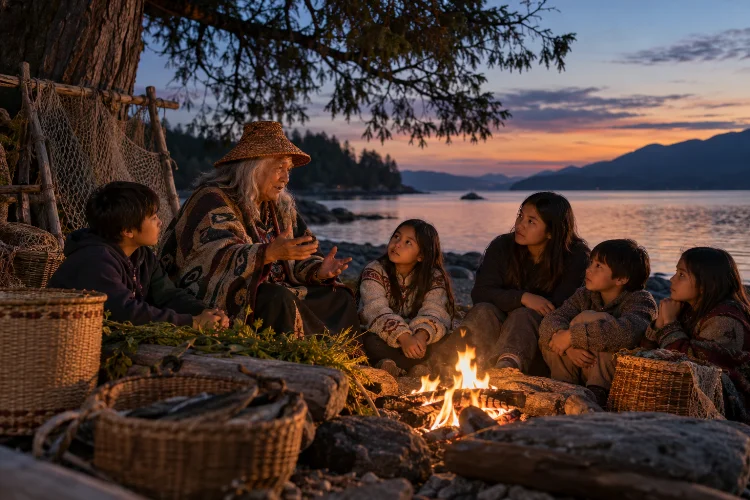
For many Indigenous communities, knowledge like this has long been passed between generations through stories, songs, conversations, ceremonies, place names, and direct teaching on the land.
This is why oral traditions preserve Indigenous environmental knowledge in ways that go far beyond simple storytelling.
A narrative about an ancestor may also describe a river system. A song can encode seasonal information, while the name of a landscape feature may remind listeners where particular plants, animals, or water sources are found.
UNESCO recognizes oral traditions as important vehicles for passing on knowledge, cultural values, and collective memory.
These knowledge systems are also highly diverse. There is no single Indigenous method of environmental teaching.
Each community develops its own ways of remembering and communicating relationships with land, water, climate, plants, animals, and the wider living world.
Oral Tradition Works Like a Living Knowledge Archive
An archive does not always need shelves, books, or databases.
Knowledge can also be stored in people.
UNESCO notes that oral traditions include myths, legends, songs, chants, poems, proverbs, prayers, and other spoken forms. These traditions help transmit collective memory and social knowledge between generations.
Environmental information can become part of these forms.
A story may explain where a particular animal lives or why a place should be approached carefully. A song might correspond with a migration, flowering period, rainfall pattern, or harvesting season.
The advantage is that information becomes memorable.
Instead of learning isolated ecological facts, younger community members encounter knowledge inside narratives involving people, ancestors, animals, landscapes, and responsibilities.
Oral knowledge is also flexible.
Stories can respond to changing circumstances while retaining important principles. This makes oral tradition less like a fixed database and more like a living cultural archive that is continuously interpreted.
Stories Can Carry Detailed Knowledge of Local Ecosystems
East Rennell in the Solomon Islands provides a powerful example.
UNESCO describes storytelling as central to cultural continuity among Indigenous communities living around the East Rennell World Heritage Site.
Oral traditions, myths, and rituals transmit knowledge involving navigation, climate patterns, resource management, and sustainable living.
This knowledge matters because local livelihoods remain closely connected with forests, Lake Tegano, coastal environments, fishing, and subsistence agriculture.
Stories therefore carry practical information.
Someone learning about an ancestral journey may also learn about safe routes, freshwater, winds, marine conditions, or culturally significant locations.
That combination is important.
From an outside perspective, it might be tempting to separate a story into “myth” and “environmental data.” Within the cultural system, however, those categories may not be divided so neatly.
The narrative works because ecology, history, spirituality, and place are remembered together.
Language Stores Knowledge That Can Be Difficult to Translate
Environmental knowledge often depends on vocabulary.
A community may have precise words for plants, animal behavior, soil conditions, weather patterns, water, seasonal changes, or landscape features.
Those words do more than label objects.
They can contain clues about how people understand ecological relationships.
The Zápara people of Ecuador and Peru offer a striking example. UNESCO describes their oral heritage as particularly rich in knowledge of the Amazonian environment, including extensive vocabulary for local flora and fauna and detailed understanding of medicinal plants.
Their language functions as a repository of both cultural memory and ecological knowlege.
This is why language loss can also become environmental knowledge loss.
UNESCO warns that when Indigenous languages disappear, the transmission of living heritage can be interrupted, potentially taking culturally specific ecological understanding with it.
Translation can preserve some information, but not always the relationships contained within the original words.
Protecting Indigenous languages therefore supports both cultural continuity and environmental memory.
Seasonal Stories Teach People When to Act
Knowing what exists in an environment is only part of ecological knowledge.
Timing can be equally important.
When should a particular fruit be gathered? When are animals breeding? When might heavy rainfall begin? When is fire appropriate for managing vegetation?
Aboriginal and Torres Strait Islander seasonal calendars demonstrate how closely these questions can be connected.
CSIRO explains that Indigenous seasonal knowledge in Australia combines observations of plants, animals, water, weather, fire, and even stars. These signs can indicate when foods are available, animals are breeding, and land or sea management activities should occur.
Among Ngan’gi knowledge holders in northern Australia, thirteen main seasons are recognized, with several periods connected to changes in spear grass and other ecological indicators.
Traditionally, such knowledge survives through repeated observation, language, teaching, and cultural practice.
A child accompanying an experienced adult is not merely being told that a season has changed.
They learn how to recognize the change themselves.
Place Names and Landscape Stories Create Memory Maps
Oral traditions can turn entire landscapes into memory systems.
A hill, river, spring, rock formation, fishing ground, or forest clearing may be linked with a name or narrative that carries cultural information.
This creates something similar to a mental map.
Instead of coordinates, people remember relationships between stories and places.
UNESCO notes that Indigenous understandings of nature can be expressed through oral traditions, language, spirituality, memories, attachment to places, and broader worldviews.
The ancestral knowledge systems of the Arhuaco, Kankuamo, Kogui, and Wiwa peoples of Colombia’s Sierra Nevada de Santa Marta show this principle clearly.
Their knowledge connects rivers, snow-capped peaks, sacred places, ceremonies, songs, spiritual responsibilities, and relationships with nature. Knowledge is transmitted through language, cultural practice, and community activities.
The landscape itself becomes part of the teaching system.
People remember knowledge because they can physically visit the places where stories belong.
Oral Teaching Makes Environmental Knowledge Practical
Storytelling is rarely the only method of learning.
Young people may hear a story and then practice the knowledge it contains.
They go fishing, collect plants, observe animal tracks, manage fire, travel through particular environments, or prepare traditional foods with experienced relatives.
This combination of oral explanation and direct participation makes knowledge practical.
CSIRO’s work with Indigenous seasonal calendars shows how older and younger generations can use environmental knowledge together.
Some calendars have also become educational resources supporting the teaching of both local language and ecological knowledge.
The process is more powerful than memorizing a list.
A plant name becomes connected with its smell, habitat, season, preparation, and cultural significance.
A weather story becomes connected with actual clouds and winds.
Learning happens through several senses at once.
That is why access to Country or ancestral territory can be so important for maintaining traditonal environmental knowledge.
Oral Knowledge Can Adapt to Environmental Change
Traditional knowledge is sometimes wrongly imagined as information frozen in the distant past.
In reality, Indigenous knowledge systems can change through continued observation.
FAO describes Indigenous knowledge as combining inherited traditions with newer innovations. Long histories of observing natural cycles, weather, and wildlife allow communities to continually respond to changing conditions.
Oral transmission can support that flexibility.
If an animal arrives later than previous generations expected, people can discuss the change. If rainfall patterns shift, new observations can become part of contemporary teaching.
East Rennell communities are already experiencing rising seas, unpredictable weather, stronger cyclones, and changes affecting freshwater systems. UNESCO notes that intergenerational environmental knowledge can help communities detect these changes and adjust decisions.
Tradition therefore does not necessarily mean repeating exactly what ancestors did.
Continuity can also mean using inherited ways of observing the world to respond intelligently to new conditions.
Losing Oral Traditions Can Mean Losing Ecological Knowledge
Oral systems depend on transmission.
If younger generations no longer speak the language, visit ancestral landscapes, learn from elders, or practice traditional livelihoods, the chain can weaken.
FAO identifies language loss and erosion of intergenerational knowledge as major threats to Indigenous traditional knowledge systems.
Displacement creates another challenge.
Someone cannot easily teach the meaning of a particular river, forest, animal migration, or sacred landscape when the comunity no longer has access to that place.
Formal education can also unintentionally contribute to knowledge loss when Indigenous languages and local knowledge are excluded from classrooms.
There are encouraging responses.
The Mayangna people of Nicaragua have worked with UNESCO to document extensive knowledge of local flora and fauna and integrate community knowledge, culture, and language into educational materials.
Documentation can help, but it should support living transmission rather than replace it.
A recorded story is valuable. A community still able to tell, interpret, and practice that story is even more important.
Knowledge Preservation Requires Community Control
Growing interest in Indigenous environmental knowledge creates an important ethical issue.
Not every story or piece of ecological information is public.
Some knowledge may belong to particular families, elders, cultural specialists, genders, or communities. Certain places or practices may also be restricted.
CSIRO explicitly recognizes Indigenous Cultural and Intellectual Property in its seasonal calendar projects, emphasizing the authority and control of Indigenous knowledge holders over the information they choose to share.
This principle matters.
Preserving oral knowledge should not mean extracting stories from communities and placing them in outside databases without permission.
The most sustainable approach supports Indigenous languages, teachers, land access, cultural institutions, and community-led education.
Knowledge survives best when the people who hold it remain able to decide how it is taught, used, and protected.
Oral traditions preserve Indigenous environmental knowledge by turning information about land, water, plants, animals, weather, and seasons into memorable cultural forms.
Stories can map landscapes, songs can reinforce seasonal knowledge, languages can preserve ecological categories, and conversations between generations can teach people when and how to harvest resources responsibly.
Examples from East Rennell, Amazonian Zápara communities, Indigenous Australian seasonal calendars, and the Sierra Nevada de Santa Marta show that environmental knowledge is often inseparable from cultural identity.
Protecting that heritage means more than recording stories before they disappear.
Support for Indigenous languages, ancestral territories, intergenerational learning, and community authority is essential.
To understand oral tradition deeply, listen not only for the story itself, but for the environmental knowledge, responsibilities, and relationships carried within it.