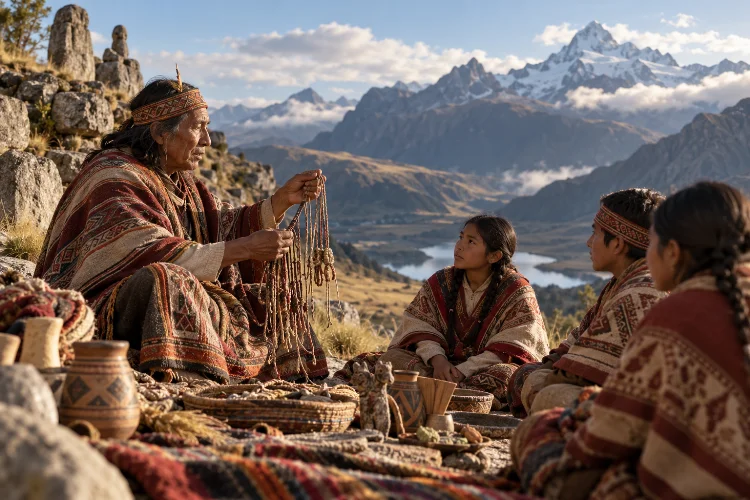
Imagine trying to preserve centuries of history without printed books, digital archives, or an alphabetic writing system. For ancient societies living across the Andes, remembering the past required a completely different set of tools.
From the desert coast of Peru to high-altitude settlements in the mountains, communities developed sophisticated ways to record identity, ancestry, political obligations, religious beliefs, and important events.
Some information was stored in knotted cords known as khipu, while other memories survived through storytelling, textiles, ceramics, sacred landscapes, and rituals involving ancestors.
Understanding how ancient Andean societies preserved their cultural memory also challenges the idea that written documents are the only reliable way for civilizations to remember.
The Inca are the best-known example, but they inherited a much older Andean tradition. Paracas, Nasca, Moche, Wari, Tiwanaku, Chimú, and other cultures all developed visual and ritual systems that connected present communities with earlier generations.
In the Andes, memory was not simply recorded. It was woven, performed, carried, visited, and experienced.
Khipu Turned Knots Into Information
Perhaps the most famous Andean memory technology was the khipu, sometimes spelled quipu.
Khipus consisted of a main cord with pendant cords attached to it. Knots, their positions, cord colors, directions of twisting, and other physical characteristics could encode information.
Inca administrators used these devices for practical purposes such as census information, tribute obligations, inventories, and accounting. Specialized experts known as khipukamayuq were responsible for creating, interpreting, and maintaining them.
Khipu were especially useful for governing an enormous empire containing millions of people across dramatically different environments.
Their role may have gone beyond numbers.
Colonial accounts suggest that some khipu specialists used cords alongside oral testimony when recalling historical narratives.
Researchers still debate exactly how much narrative information surviving khipus encoded, so describing them simply as “books made of knots” would go too far.
What is clear is that they provided a physical structure through which information could survive beyond one person’s memory.
Oral Tradition Kept History Alive Through Performance
Not every memory needed a physical object.
Oral history was another major way Andean societies transmitted knowledge. Stories about rulers, migrations, battles, sacred ancestors, and origins could be repeated from one generation to the next.
For the Inca, remembering political history appears to have involved specialized knowledge keepers as well as public performance. Early colonial evidence describes traditions in which important rulers and their achievements were commemorated through songs and narratives.
This did not mean stories were repeated word for word forever.
Oral traditions could change as political circumstances changed. Communities might emphasize certain ancestors, reinterpret earlier events, or connect the past with contemporary claims to land and authority.
That flexibility was actually part of the system.
Cultural memmory was not a frozen database. It remained relevant because people repeatedly retold it within new social situations.
Textiles Carried Identity Across Generations
Few materials were as important in the ancient Andes as cloth.
Andean textile traditions developed over thousands of years, and sophisticated weaving appeared long before the Inca Empire.
The Metropolitan Museum of Art notes that textiles communicated political, social, occupational, and ancestral identities through materials, colors, and patterns.
A garment could therefore tell people who someone was.
Regional patterns, weaving techniques, fibers, and colors helped express affiliation and status. Among the Wari, for example, prestigious tapestry tunics were highly standardized, suggesting organized production and strong connections between clothing and political identity.
Some examples required extraordinary amounts of finely spun camelid fiber.
Cloth also accompanied people into death.
Paracas communities famously wrapped important individuals in elaborate layers of textiles, creating large funerary bundles. These fabrics did more than protect a body—they carried imagery, status, belief, and social identity into the ancestral world.
In this sense, weaving functioned almost like a cultural archive made from fiber.
Ancestors Made the Past Physically Present
For many ancient Andean societies, deceased ancestors were not simply people who belonged to history.
They could remain active members of the community.
Important individuals were sometimes transformed into carefully prepared mummy bundles covered with valuable garments, ornaments, masks, and other objects. Communities could maintain relationships with these ancestors long after death.
Evidence from later Inca practices shows that ancestor bundles could even be brought out during special ceremonies and processions. Earlier Andean traditions indicate that this relationship between the living and ancestral dead had much deeper roots.
Why was this so important for cultural memory?
An ancestor gave history a recognizable identity.
Instead of saying that a particular family or community possessed rights because of an abstract event hundreds of years earlier, people could connect authority directly with respected predecessors.
Ancestor rituals therefore preserved genealogy, political legitimacy, territorial claims, and religious beliefs at the same time.
The past could literally participate in the present.
Ceramics and Art Became Visual Storytelling
Andean cultures also preserved ideas through images.
Pottery vessels, metal objects, carved stone, textiles, and painted surfaces carried recurring figures of animals, warriors, supernatural beings, ceremonies, agricultural products, and elite individuals.
The British Museum notes that because ancient Andean societies did not depend on conventional written scripts, textiles and ceramics became important surfaces for communicating symbolic ideas and beliefs.
Moche ceramics provide an especially vivid example.
Finely modeled vessels depict warriors, animals, ritual activities, supernatural figures, and remarkably individualized human faces. Repeated themes allowed cultural knowledge to circulate through recognizable visual forms.
Images did not necessarily function like sentences in a book.
Instead, viewers who already understood the cultural context could recognize stories, social roles, religious symbols, or expected behaviours.
The object acted as a trigger for remembered knowledge.
Sacred Landscapes Stored Memory in Place
Sometimes the landscape itself became an archive.
Mountains, springs, caves, rocks, roads, agricultural terraces, and other natural features could carry sacred meaning. Stories tied communities to specific places, making geography inseparable from cultural identity.
The Nasca Lines offer one of the most famous examples.
Created on the southern Peruvian desert plain, the Nasca and Palpa geoglyphs include enormous geometric patterns, animals, plants, and other figures.
UNESCO dates the broader tradition from roughly 500 BCE to 500 CE and describes the area as a highly symbolic ritual and social landscape.
Many interpretations of individual geoglyphs remain debated.
However, archaeological evidence suggests that people moved through parts of the landscape during ceremonies, turning physical movement into ritaul experience.
Walking a route repeatedly can preserve memory in a powerful way.
A story becomes attached to a hill. A ceremony belongs to a certain path. An ancestor is associated with a particular place.
Instead of consulting an archive, people entered the landscpae where their history had happened.
Rituals Repeated Cultural Knowledge
Memory becomes stronger when people repeat it.
Seasonal festivals, funerals, sacrifices, agricultural ceremonies, political gatherings, and religious processions allowed Andean communities to reproduce cultural knowledge again and again.
Participants did not simply hear stories about their traditions. They performed them.
Mortuary practices are especially useful for understanding this process.
Research on ancient Andean burial traditions shows that funerary rituals could function as spaces of intergenerational learning, teaching younger participants how death, ancestry, and social relationships should be understood.
Repetition made cultural knowledge durable.
Children could watch adults prepare offerings, participate in ceremonies, learn songs, recognize sacred objects, and visit ancestral places.
Even when political states disappeared, some religious symbols, craft traditions, and relationships with sacred landscapes continued because communities carried the practices forward.
Cultural Memory Was Spread Across Many Different Media
One important lesson from ancient Andean history is that memory rarely depended on just one system.
A khipu might preserve administrative information, while a storyteller explained historical meaning. Textiles displayed identity, ancestors embodied genealogy, and ritual landscapes connected communities to sacred geography.
These systems reinforced one another.
That made Andean memory surprisingly resilient.
If one medium disappeared, knowledge could survive through another. Stories might continue even if an object was destroyed.
Visual patterns could remain meaningful after a kingdom collapsed. Sacred locations could preserve traditions long after political borders changed.
Spanish colonization dramatically disrupted these systems, particularly through religious suppression and the destruction or reinterpretation of indigenous institutions.
Yet many Andean cultural traditions did not disappear.
Quechua and Aymara oral traditions, weaving practices, communal ceremonies, and relationships with mountains and sacred places continue to show how deeply historical memory remains embedded within the region.
Ancient Andean societies preserved cultural memory through far more than written records.
Khipu organized information, oral traditions carried historical narratives, textiles expressed identity, ancestors maintained links with earlier generations, and sacred landscapes transformed geography into repositories of meaning.
Ceramics, rituals, songs, clothing, and funerary practices added even more layers to this complex memory system.
Together, these traditions demonstrate that societies can build remarkably sophisticated archives without conventional books or scripts. In the Andes, remembering was often an active social process – something performed, worn, touched, walked through, and shared.
If you want to understand ancient Andean civilizations beyond famous ruins such as Machu Picchu, start by exploring how they remembered. Their systems of cultural preservation reveal a world in which history remained closely connected to everyday life.