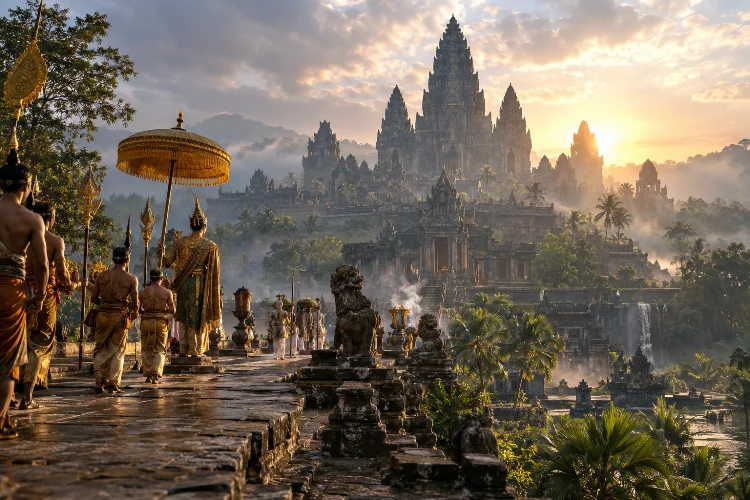
Imagine entering an early Southeast Asian capital and seeing a huge temple rising above the surrounding landscape. To modern eyes, it might look like an impressive religious monument.
To people living there centuries ago, however, the building could communicate something much bigger: the ruler, the gods, the kingdom, and the universe were all connected.
This idea lies at the heart of sacred kingship in early Southeast Asian kingdoms.
Between roughly the first millennium CE and the rise of later medieval states, rulers across Cambodia, Java, mainland Southeast Asia, and neighboring regions borrowed religious ideas from South Asia while reshaping them around local traditions.
Hindu concepts of divine authority existed alongside Buddhist ideas of the righteous or universal ruler.
Kings were not simply political administrators. They sponsored temples, performed ceremonies, protected religious institutions, and presented themselves as guardians of cosmic order.
Understanding sacred kingship therefore gives us a different way to read Southeast Asian history.
Temples such as Borobudur, Prambanan, and those at Angkor were not simply religious buildings – they also expressed ideas about goverance, legitimacy, and the organization of society.
Sacred Kingship Was About More Than Calling a King a God
The phrase “god-king” is often used to describe ancient Southeast Asian rulers, but the historical reality was more complicated.
Some rulers were closely associated with Shiva, Vishnu, the Buddha, or other sacred figures. Elsewhere, royal authority emphasized the king as a cakravartin, an ideal universal ruler who governed according to religious and moral principles.
Scholars studying Angkor, Pagan, Dvaravati, and other early states have shown that several models of kingship could exist together. These included Hindu divine rulership, Buddhist kingship, and the concept of the dharmaraja, or righteous ruler.
Local traditions mattered too.
Southeast Asian societies did not simply copy an Indian political system. Rulers adapted Sanskrit titles, rituals, religious imagery, and cosmology to existing ideas about ancestors, spirits, sacred landscapes, and personal power.
Sacred kingship was therefore a flexible political language rather than one fixed formula.
Indian Religious Ideas Were Adapted to Local Political Needs
From the early centuries CE, Southeast Asia became increasingly connected with South Asia through maritime trade.
Along with merchants and luxury goods came Sanskrit literature, Hindu traditions, Buddhism, artistic styles, and new ideas about rulership. The Mekong Delta and other trading regions became important centers where these influences interacted with local cultures.
For ambitious rulers, the new religious vocabulary was useful.
A king associated with Shiva or Vishnu could claim more than military strength. His authority could be presented as part of a much larger cosmic structure.
Sanskrit inscriptions reinforced these claims by comparing kings to divine or legendary figures. Religious donations also demonstrated generosity, wealth, and the ability to maintain order.
But this was never a simple story of “Indianization.”
At sites such as Sambor Prei Kuk, Hindu traditions mixed with Buddhist and animist elements, demonstrating how imported ideas were transformed into distinctly Southeast Asian forms.
The Devaraja Tradition Became Closely Associated With Khmer Kingship
No discussion of sacred kingship in Southeast Asia is complete without the devaraja tradition.
The concept is famously connected with Khmer ruler Jayavarman II. According to the later Sdok Kak Thom inscription, a ceremony associated with royal sovereignty took place during his reign in the early ninth century.
UNESCO identifies Phnom Kulen, or ancient Mahendraparvata, as a major symbolic location where Jayavarman II proclaimed sovereignty in 802 CE and where the devaraja cult became associated with the emerging Khmer Empire.
Older interpretations often translated devaraja simply as “god-king,” suggesting that the ruler himself was worshipped directly as a deity.
Modern scholarship is more cautious.
The concept may instead have involved a royal cult linking kingship, Shiva, sacred ritual, and political sovereignty. The exact meaning remains debated, but its political importance is clear: royal power was presented as something supported by the sacred world.
Temple Mountains Turned Political Authority Into Architecture
Sacred kingship was not expressed only through ceremonies or inscriptions. It was built into the landscape.
Khmer rulers constructed monumental temple mountains representing Mount Meru, the cosmic mountain at the center of Hindu and Buddhist cosmology.
This symbolism made architecture politically powerful.
A royal temple positioned at the heart of a capital could suggest that the kingdom itself reflected cosmic order. The king stood near the symbolic center of this carefully organized universe.
At Angkor, state temples, reservoirs, roads, palaces, and ceremonial landscapes created an enormous environment in which religion and political autority were difficult to separate.
UNESCO notes that early Khmer capitals commonly placed a state temple at their center, while rulers and elites sponsored additional religious monuments.
Later monuments continued the pattern.
The Bayon, constructed under Jayavarman VII, occupied the center of Angkor Thom and was conceived within a sacred landscape resembling a mandala and Mount Meru.
Java Developed Its Own Powerful Forms of Sacred Rule
Sacred rulership was not limited to the Khmer world.
Central Java became home to powerful Hindu and Buddhist dynasties during the eighth and ninth centuries. The Sailendra rulers, for example, sponsored one of Southeast Asia’s most extraordinary monuments: Borobudur.
Built around 800 CE, Borobudur was designed as a monumental Buddhist sacred landscape. Its terraces and galleries create a symbolic journey from the realm of desire toward higher states of spiritual enlightenment.
A ruler capable of sponsoring such a monument communicated several things at once.
The project demonstrated control over labor and resources, devotion to Buddhism, and participation in a cosmic religious order. Monumental construction therefore served spiritual and political purposes simultaneously.
Nearby Hindu kingdoms developed similarly ambitious traditions. Prambanan, associated with the worship of Shiva, Vishnu, and Brahma, demonstrates how different religious systems could support royal legitimacy within the same broad Javanese cultural environment.
Buddhist Kingship Offered Another Model of Royal Authority
Not every sacred king needed to present himself through Hindu divine associations.
Buddhist traditions developed their own powerful models of rulership.
One was the cakravartin, often described as a universal or wheel-turning monarch. Ideally, such a ruler maintained order and supported the Dharma rather than ruling purely through violence.
Another model was the dharmaraja, the righteous king.
Buddhist rulers could gain merit by building temples, supporting monks, commissioning religious images, and protecting monasteries. Their political authority was strengthened by demonstrating moral and religious responsibility.
This approach became influential across mainland Southeast Asia.
Scholars have identified related ideas of Buddhist kingship in places including Pagan, Angkor, Dvaravati, and neighboring regions.
Jayavarman VII of Angkor provides a particularly famous example, as his reign strongly promoted Mahayana Buddhism while maintaining the monumental traditions of Khmer kingship.
Sacred Kingship Helped Hold Expanding Kingdoms Together
Early Southeast Asian kingdoms often contained diverse populations spread across large territories.
There were no modern communication networks, national media, or bureaucracies comparable to contemporary states. Maintaining loyalty across distant regions could therefore be difficult.
Sacred rulership offered one solution.
Royal temples created visible centers of power. Religious ceremonies connected the court with priests and local elites. Inscriptions publicized royal donations, military achievements, ancestry, and devotion.
The ruler became a simbolic center around which political relationships could be organized.
This did not mean that every village was tightly controlled by the capital. Early states could have flexible boundaries, regional elites, and shifting networks of loyalty.
Still, sacred authority gave rulers a language for claiming supremacy beyond their immediate court. By presenting political order as part of cosmic order, kings could make loyalty feel religious as well as political.
The Legacy of Sacred Kingship Can Still Be Seen Today
The political systems that created these monuments eventually changed, but their landscapes survived.
Angkor, Borobudur, Prambanan, Sambor Prei Kuk, and other archaeological sites remain among Southeast Asia’s most recognizable cultural landmarks.
Their architecture helps explain how early rulers imagined power.
A temple mountain was not simply an impressive place of worship. A royal inscription was not merely decoration. A Buddhist monument was not necessarily separate from politics.
Together, these objects and landscapes reveal societies in which religion, political legitimacy, cosmology, and social hierarchy constantly overlapped.
They also show that early Southeast Asian comunities were active cultural innovators. Hindu and Buddhist ideas arriving from abroad were selected, combined, and reshaped to meet local political and religious needs.
That process produced traditions of kingship that were distinctly Southeast Asian.
Sacred kingship helped early Southeast Asian rulers transform political authority into something much larger than personal power.
Through temples, religious ceremonies, inscriptions, sacred landscapes, and royal patronage, kings could present themselves as protectors of cosmic and social order.
The Khmer devaraja tradition is one famous example, but it was only part of a broader regional story. Buddhist ideas of the cakravartin and dharmaraja, Javanese temple patronage, and local traditions all contributed to different models of legitimate rulership.
Studying these systems also changes how we look at monuments such as Angkor and Borobudur. They were not just architectural masterpieces; they were statements about how society and the universe were believed to fit together.
Explore their temples, inscriptions, and sacred landscapes, and Southeast Asia’s early kingdoms begin to tell a far richer political story.