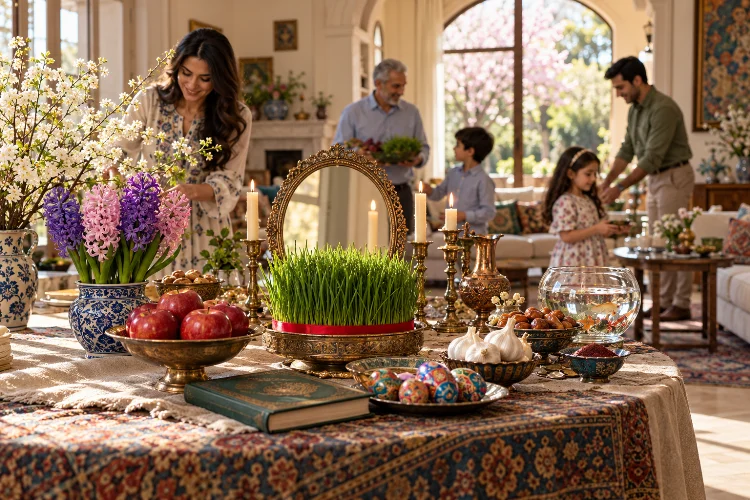
Every year around the spring equinox, millions of people welcome a “new day.” Homes are cleaned, families gather, sprouts appear on decorated tables, and the arrival of spring becomes the beginning of another cycle.
This celebration is Nowruz, the Persian New Year.
Understanding the ancient roots of Persian Nowruz celebrations takes us far beyond today’s Haft-Seen tables and holiday visits. The festival developed from ancient Iranian ideas about seasonal renewal, calendars, family, nature, and the struggle between life and winter.
Its exact starting point is difficult to reconstruct. Nowruz is not named in the surviving Avesta, the sacred collection of Zoroastrian texts, and historians are cautious about assigning every modern custom directly to ancient Persia.
Still, later Zoroastrian writings and Iranian historical traditions clearly connect the festival with spring and the renewal of creation.
Over centuries, Persian kings, Zoroastrian communities, Muslim societies, and ordinary families reshaped the celebration while preserving one remarkable idea: a changing season can also become a moment for changing life.
Nowruz Began With the Powerful Idea of a “New Day”
The Persian word Nowruz literally means “new day.”
At its core, the festival celebrates renewal at the beginning of spring. The return of warmth, new plant growth, longer days, and agricultural activity naturally made this point in the year feel like a fresh beginning.
UNESCO describes Nowruz as an ancestral celebration marking the first day of spring and the renewal of nature. Today it is observed across Iran, Central Asia, the Caucasus, parts of South Asia, and neighboring regions.
The relationship with the spring equinox became particularly important.
Ancient Iranian calendar systems changed over time, and keeping festivals aligned perfectly with the seasons was not always simple.
Encyclopaedia Iranica notes that Iranian religious specialists worked to connect Nowruz with the spring season and the beginning of the yearly ritual cycle.
This means Nowruz was not simply a numbered date.
It represented the return of life after winter.
Zoroastrian Traditions Shaped the Festival’s Spiritual Meaning
Nowruz is frequently associated with Zoroastrianism, the ancient Iranian religion that flourished long before the Islamic conquest of Persia.
However, its history needs a little nuance.
The word Nowruz itself does not appear in surviving Old or Young Avestan texts. Its name appears clearly in later Middle Persian, or Pahlavi, sources. That makes it difficult to identify one exact historical moment when the festival began.
Even so, its symbolism fits strongly within the Zoroastrian worldview.
Zoroastrian thought places great importance on truth, order, life, light, and the continuing struggle against destructive forces. Spring naturally reflects many of these ideas: darkness retreats, vegetation returns, and the world appears renewed.
Ancient seasonal festivals known as gahambars also organized religious time around creation and agricultural cycles.
Nowruz eventually became one of the most important moments of this yearly system.
For Zoroastrian communities, renewal was therefore not only botanical. The changing landscape could reflect a larger religious vision of creation becoming healthy and complete.
Persian Empires Turned Nowruz Into a Royal Celebration
Popular descriptions sometimes claim that the Achaemenid kings built Persepolis specifically for Nowruz celebrations.
That idea is attractive, but direct historical evidence remains uncertain.
What we can say more confidently is that Iranian rulers developed sophisticated calendars and court ceremonies, while later Persian traditions strongly associated kingship with New Year festivities.
The Sasanian Empire, which ruled Iran from 224 to 651 CE, provides clearer evidence.
Smithsonian’s National Museum of Asian Art notes that spring New Year celebrations became major annual ceremonies under the Sasanians. The ruler received representatives, subjects, and members of the court, turning seasonal renewal into a demonstration of political order.
This changed the meaning of the festival.
Nowruz could simultaneously celebrate spring, royal authority, generosity, and the stability of the kingdom.
Gift exchanges and formal audiences also gave different groups opportunities to reaffirm their relationship with the ruler.
The natural world was starting again, and symbolically, so was the political order.
Fire Traditions Reflect an Older Iranian Symbolic World
Fire remains closely associated with Iranian cultural traditions, and it plays a visible role before modern Nowruz through Chaharshanbe Suri.
On the evening before the final Wednesday of the Persian year, people traditionally light small fires and jump over them.
It is tempting to describe the entire custom as an unchanged Zoroastrian ritual.
The history is more complicated.
Fire held profound sacred importance in ancient Iranian religion, but Encyclopaedia Iranica explains that the specific Wednesday timing and some features of Chaharshanbe Suri appear to have developed after the Islamic conquest.
Earlier Iranian celebrations nevertheless included fire rituals, and references to lighting fires near the end of the year existed before the modern custom took its present form.
The modern ceremony therefore contains several historical layers.
Today, jumping over fire commonly expresses ideas of vitality, health, purification, and leaving weakness or misfortune behind.
Fire becomes a powerful simbolic boundary between the old year and the new one.
Remembering the Dead Was Once Closely Connected With Renewal
A festival of new life might seem like an unusual time to remember the dead.
In ancient Iranian tradition, however, these ideas could exist together.
Zoroastrian observances before Nowruz involved remembrance of the fravashis, protective spiritual aspects associated with the departed. Families symbolically welcomed deceased relatives and later bid them farewell as the New Year began.
Encyclopaedia Iranica describes traditions in which families honored departed relatives through religious ceremonies, shared food, stories, music, and remembrance.
The connection makes cultural sense.
A new year does not erase earlier generations. Instead, the family enters another cycle while remembering the people who came before.
That principle survived in different forms across Iranian history.
It also helps explain why Nowruz remains strongly centered on family rather than functioning simply as a public seasonal celebraton.
Renewal looks forward, but cultural memory looks backward at the same time.
Haft-Seen Combines Old Symbols With Newer Traditions
Today, one of the most recognizable features of Iranian Nowruz is the Haft-Seen table.
Families arrange at least seven items whose Persian names begin with the letter sin, or “s.” Common examples include sabzeh (sprouts), sib (apple), senjed (oleaster fruit), serkeh (vinegar), samanu (sweet wheat pudding), sumac, and seer (garlic).
Other objects may include candles, eggs, flowers, coins, a mirror, water, poetry, or a religious book.
Many of these objects symbolize concepts such as growth, fertility, health, sweetness, prosperity, or renewal.
However, the familiar seven-S format should not automatically be projected thousands of years into the past.
Encyclopaedia Iranica notes that the precise history of Haft-Seen is obscure and that the standardized custom as practiced today may be comparatively recent.
At the same time, several components of the broader Nowruz table – sprouted grains, water, candles, eggs, and food – have much older cultural associations.
This is a perfect example of how living traditions evolve.
The format changes while older symbols continue underneath it.
Spring Cleaning Turns Renewal Into Everyday Action
One of the most practical Nowruz traditions is khaneh tekani, literally “shaking the house.”
Families thoroughly clean their homes before the New Year.
Carpets may be washed, rooms reorganized, unwanted objects removed, and household spaces refreshed.
The custom makes an abstract idea physically visible.
Rather than simply saying a new year has begun, people prepare a home that feels different from the one they occupied before.
New clothes reinforce the same idea.
Visiting relatives and friends then expands renewal from the household to the wider comunity. Old connections are refreshed, children receive gifts, and relationships receive attention after another year has passed.
UNESCO emphasizes these social dimensions of Nowruz, including family visits, meals, gifts, reconciliation, and solidarity between generations.
Renewal therefore happens at several levels: nature, home, family, and society.
Nowruz Survived Major Religious and Political Changes
Perhaps the most remarkable part of Nowruz history is its endurance.
The Sasanian Empire disappeared after the Arab conquest in the seventh century. Iran gradually became predominantly Muslim, and the political and religious landscape changed dramatically.
Nowruz survived.
Persian-speaking Muslim courts continued celebrating it, including dynasties such as the Ghaznavids. Poetry, music, royal ceremonies, seasonal imagery, and gift exchange allowed the festival to develop in new cultural settings.
This survival demonstrates how cultural traditions can move beyond their original religious context.
For some communities, Nowruz retained strong Zoroastrian significance. For others, it became primarily a Persian or regional New Year celebration compatible with Muslim life.
Today it is celebrated by communities with different ethnic and religious identities.
Rather than remaining frozen in antiquity, the traditon survived because people repeatedly adapted it.
Nowruz Became a Shared Heritage Beyond Persia
Although Nowruz has deep Iranian roots, it is no longer meaningful only within Iran.
Different forms of the festival are celebrated across Afghanistan, Azerbaijan, Kazakhstan, Kyrgyzstan, Tajikistan, Turkey, Turkmenistan, Uzbekistan, parts of Iraq, Pakistan, India, and other communities.
Local names, foods, games, music, and rituals differ.
UNESCO recognized the festival as Intangible Cultural Heritage in 2009 and later expanded its multinational inscription. It describes Nowruz as a tradition promoting intergenerational solidarity, cultural diversity, reconciliation, and community ties.
That diversity is part of its cultural legacy.
An ancient celebration associated with Iranian springtime became something communities across a vast region could adapt to their own landscapes and histories.
The “new day” kept finding new homes.
The ancient roots of Persian Nowruz celebrations reveal a festival built around one enduring idea: life can begin again.
Its history connects springtime renewal with ancient Iranian calendars, Zoroastrian religious thought, remembrance of ancestors, Persian kingship, fire symbolism, and the changing agricultural year.
Later traditions such as Haft-Seen, spring cleaning, family visits, and gift giving added new layers without erasing the festival’s older themes.
Nowruz also survived empires, religious transformations, migration, and political change because it never belonged only to one historical moment.
To understand the Persian New Year more deeply, look beyond the decorated table. Explore its calendars, ancient beliefs, fire traditions, family customs, and seasonal symbolism, and Nowruz becomes not just a holiday but a living connection between past and present.