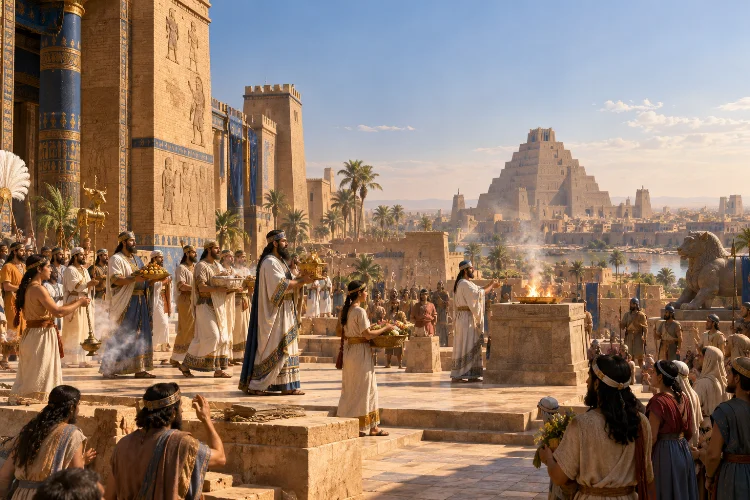
Long before national flags, public holidays, or sports teams gave people a shared identity, communities in ancient Mesopotamia had something equally powerful: ritual.
From temple offerings and religious processions to seasonal festivals, these repeated practices gave people a sense of belonging. They reminded residents not only which gods they worshipped, but also which city, ruler, traditions, and social order they belonged to.
Ancient Mesopotamian rituals were particularly important because religion was not separated neatly from government, economics, or everyday life. In cities such as Ur, Uruk, Nippur, Babylon, and Ashur, religious institutions stood at the center of urban society.
Patron gods protected cities, priests managed ceremonies, and rulers presented themselves as servants or representatives of divine powers.
However, Mesopotamia was never a single unchanging culture. Sumerians, Akkadians, Babylonians, and Assyrians developed different traditions across thousands of years.
Even so, ritual provided one remarkably consistent mechanism for turning individuals into members of a larger community.
Religion Gave Every Mesopotamian City a Shared Center
For many ancient Mesopotamians, identity started with the city.
Major cities were associated with particular patron deities. Ur was closely linked with the moon god Nanna, while Babylon eventually became strongly associated with Marduk. Nippur held exceptional religious importance because of its connection with Enlil.
The relationship went beyond simply having a favorite god. People believed temples were genuine residences of divine beings. Maintaining a deity’s house therefore helped protect the prosperity and stability of the entire city.
This transformed religious devotion into civic identity.
A resident could understand their community as a population living under the protection of the same divine power.
The temple physically reinforced that idea by occupying an important place within the city. In some periods, monumental temple complexes also employed priests, administrators, farmers, shepherds, craftspeople, and other workers.
The result was a community linked by both belief and daily economic activity.
Temples Were More Than Places of Worship
Modern readers sometimes imagine a Mesopotamian temple as something similar to a contemporary church or mosque. The comparison only goes so far.
Most ordinary people did not simply enter the most sacred areas whenever they wanted. Inner sanctuaries were controlled by religious specialists, and access could be highly restricted.
Temples were also major institutions. They received offerings, controlled resources, employed workers, managed land, and participated in redistribution and production.
Penn Museum notes that early Mesopotamian temples could employ large numbers of people, ranging from priests to shepherds and weavers.
That made temple life part of the social fabric.
Preparing food for divine offerings, producing textiles, maintaining buildings, organizing festivals, and managing temple property connected many occupations to the sacred economy.
Even someone who never performed an important ritaul personally could participate indirectly through labor, offerings, taxes, or festival attendance.
Religion therefore created overlapping networks of responsibility that helped define what membership in a community meant.
Public Festivals Turned Belief Into Collective Experience
Daily worship mattered, but festivals were especially powerful because they brought large groups together.
Mesopotamian festivals could celebrate agricultural cycles, divine events, royal victories, temple dedications, or the New Year. People gathered around shared ceremonies, processions, music, feasting, mourning, and public displays.
One famous example was the Akitu festival.
Forms of the festival existed from early Mesopotamian history, while Babylon later became particularly famous for its elaborate New Year celebration. Ceremonies connected Marduk, the cosmic order, agricultural renewal, and royal authority.
For ordinary participants, festivals turned abstract religious ideas into visible experiences.
People could watch sacred processions, encounter divine statues that were normally housed inside temples, hear music, and participate in communal celebrations. Everyone experienced the same ceremonial calendar together.
That repetition mattered.
When thousands of people repeatedly celebrate, mourn, pray, or feast at the same time, tradition becomes a form of collective memory. A comunity does not simply remember its identity intellectually; it performs that identity.
Rituals Connected Political Authority With Divine Order
Mesopotamian rulers understood the social power of religion extremely well.
Kings regularly presented themselves as builders and restorers of temples. Inscriptions recorded rulers dedicating structures to gods, and foundation deposits could preserve the memory of royal construction projects for future generations.
One example comes from Gudea of Lagash around 2090 BCE. A surviving votive cone records his dedication connected with rebuilding the Eninnu temple of Ningirsu.
Such projects were political as well as religious.
Building a temple demonstrated that a ruler possessed wealth, labor, administrative capacity, and divine approval. It also suggested that political stability formed part of the cosmic order established by the gods.
Festivals could reinforce the same message. During important ceremonnies, the king appeared not merely as a powerful human being but as someone whose authority existed within a sacred system.
This strengthened community identity because loyalty to the city, loyalty to its gods, and loyalty to political authority could become closely intertwined.
Offerings Created Personal Connections to the Community
Not every expression of Mesopotamian religion involved spectacular public festivals.
Individuals also made offerings.
Archaeologists have discovered votive statues, plaques, bowls, inscriptions, and other objects deposited within temple contexts. Famous worshipper statues show human figures standing with clasped hands and large attentive eyes, visually expressing permanent devotion.
These objects helped connect personal religious concerns to larger institutions.
A worshipper might seek divine protection, express gratitude, commemorate a dedication, or demonstrate piety. Yet once placed inside a temple, the object became part of a shared sacred environment.
Even individual devotion therefore contributed to collective religious culture.
The survival of such objects also shows how seriously sacred materials were treated. At Nippur, for example, old temple objects were sometimes carefully deposited rather than casually discarded.
Sacred memory could literally accumulate within the architecture of the city.
Shared Rituals Helped Organize Time and Social Life
Identity is shaped not only by places but also by calendars.
Modern societies organize collective life around weekends, holidays, school years, elections, religious occasions, and anniversaries. Ancient Mesopotamian communities also experienced time through recurring ceremonies.
Agricultural festivals connected ritual activity to sowing and harvesting. New Year celebrations symbolized renewal. Mourning rites associated with deities such as Dumuzi/Tammuz offered another form of shared emotional experience.
These traditions gave time social meaning.
Instead of every household following an entirely private rhythm, recurring festivals synchronized the population. Farmers, craftspeople, officials, priests, merchants, and rulers could all recognize important moments in the same ceremonial cycle.
That synchronization strengthened identitiy because communities repeatedly returned to familiar stories, places, symbols, and practices.
Ritual Reinforced Local Identity Without Creating One Mesopotamian Culture
It is important not to treat Mesopotamia as culturally uniform.
The region contained numerous cities, languages, kingdoms, empires, and religious traditions over several millennia. The rituals practiced in Early Dynastic Sumer were not identical to those of Neo-Assyrian cities more than two thousand years later.
Local gods were especially important.
A city’s patron deity could become a powerful symbol distinguishing one urban community from another.
Political conquest could change the hierarchy among gods as well. When Babylon became a major political power, for instance, the importance of Marduk grew dramatically.
Ritual therefore worked at several levels at once.
It could strengthen neighborhood and family traditions, define membership in a city-state, legitimize kingship, and connect people to a wider Mesopotamian religious worldview.
Rather than erasing differences, shared religious practices often gave those differences a meaningful structure.
Why Mesopotamian Rituals Still Matter to Historians
Ritual gives historians a useful window into how some of the world’s earliest urban societies held themselves together.
Clay tablets, temple remains, votive statues, foundation deposits, seals, reliefs, and ritual texts reveal that belief was closely connected with social organization. Religion was not simply something people thought about privately.
It influenced labor, architecture, calendars, political power, art, and public gatherings.
That is why studying ancient Mesopotamian rituals helps us understand the development of early cities more broadly. Large urban populations needed ways to create common expectations and shared stories among people who were not all relatives or personal acquaintances.
Repeated ceremonies offered one solution.
They transformed a crowded settlement into a symbolic community with its own gods, memories, sacred places, responsibilities, and collective future.
Ancient Mesopotamian rituals did far more than honor supernatural powers. They created repeated experiences through which people learned what their community represented and where they belonged within it.
Temples gave cities sacred centers, offerings connected individuals to shared institutions, festivals synchronized public life, and royal ceremonies linked political authority with divine order.
At the same time, local patron gods helped different cities preserve distinctive identities across a culturally diverse region.
In many ways, the basic mechanism remains familiar today. Communities are still strengthened through shared celebrations, symbols, stories, places, and traditions.
If you want to understand how civilization developed beyond buildings and governments, exploring Mesopotamian religious life is a great place to start – the rituals reveal how ancient people turned cities into communities.