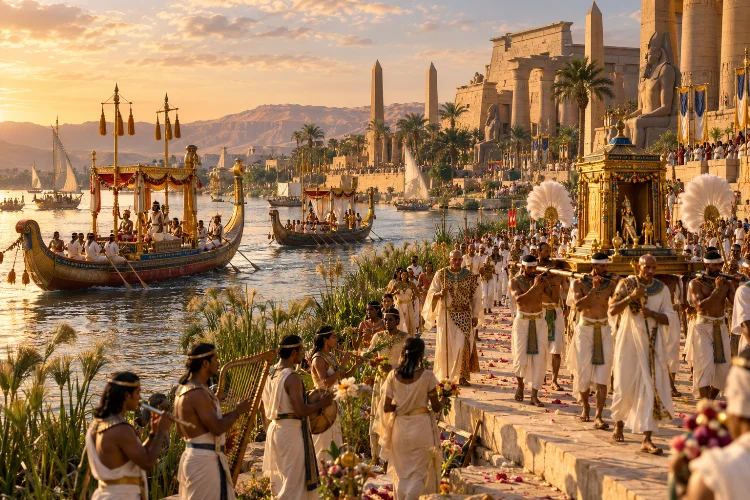
Imagine standing beside the Nile thousands of years ago while crowds gather, musicians play, priests carry a sacred shrine, and decorated boats move slowly along the river.
For ancient Egyptians, scenes like this were not simply entertainment. Festivals were moments when religion, politics, family life, agriculture, and community identity came together.
The cultural legacy of ancient Egyptian festivals reveals a society that understood celebration as something deeply meaningful.
Some events marked the beginning of a new year, while others honored gods, celebrated the dead, renewed royal authority, or followed seasonal changes connected with the Nile.
Unlike many modern holidays, these occasions could transform entire cities. Sacred images normally hidden inside temples were brought into public view, processions filled major roads, and ordinary people gained rare opportunities to participate in official religious life.
Looking at these celebrations helps us see ancient Egypt beyond pyramids and pharaohs. Festivals show how Egyptians experienced their religion in daily life – and how shared traditions helped maintain a remarkably durable culture for thousands of years.
Why Festivals Mattered So Much in Ancient Egypt
Religion was woven into almost every part of ancient Egyptian society. Gods were associated with cities, natural forces, fertility, death, kingship, and the movement of the sun.
Festivals created moments when these beliefs became public experiences rather than rituals performed only by priests inside temples.
University College London’s Digital Egypt project notes that procession was a central feature of many Egyptian festivals. During major celebrations, divine images could leave temple sanctuaries and travel through streets or along the Nile.
This was significant because most people normally had limited access to the inner areas of temples.
Festival days therefore brought the sacred world closer to ordinary communities. Music, food, religious ceremonies, boats, flowers, and large crowds turned theological ideas into experiences that people could actually see and participate in.
The celebrations also strengthened social relationships. Families gathered together, communities shared meals, and generations experienced many of the same recurring traditions.
The Opet Festival Connected Gods, Pharaohs, and the People
One of ancient Egypt’s best-known celebrations was the Opet Festival, especially important during the New Kingdom.
Centered on Thebes, modern Luxor, the festival involved the sacred images of Amun, Mut, and Khonsu. Amun’s image traveled from Karnak Temple toward Luxor Temple in a spectacular ceremonial procession.
During certain periods, sacred barques were transported along the Nile. Crowds gathered to watch while musicians, dancers, priests, officials, and other participants accompanied the event.
The festival had a strong political meaning as well.
The pharaoh’s authority was closely connected to divine order, and Opet symbolically renewed the relationship between the ruler and Amun.
In this sense, the celebration reminded people that royal authority was not presented simply as political power – it was part of the sacred structure of Egyptian society.
The duration of Opet also changed over time. By later periods of the New Kingdom, celebrations could continue for many days, making it one of the most important public religous occasions in Thebes.
Wepet-Renpet Celebrated Renewal and a New Beginning
Ancient Egyptians also celebrated Wepet-Renpet, usually translated as “Opening of the Year.”
The Egyptian calendar was closely connected with agricultural seasons and the rhythms of the Nile. Ideally, the beginning of the year was associated with the annual inundation, an event essential for agriculture because floodwaters renewed farmland with moisture and fertile sediment.
New Year celebrations therefore carried powerful symbolism.
Renewal was not simply about changing a date on a calendar. It reflected broader Egyptian ideas about regeneration, cosmic order, and the constant renewal of life.
The annual cycle echoed patterns visible throughout Egyptian religion: the sun disappeared and returned, crops died and grew again, the Nile rose and fell, and humans hoped for continued existence after death.
Evidence from New Kingdom Thebes also shows processions connected with New Year celebrations. Priests could carry sacred vessels while temples underwent ritual purification.
These practices made the new year both a social celebration and a symbolic restoration of order.
The Beautiful Festival of the Valley Linked the Living and the Dead
Perhaps one of the most emotionally interesting Egyptian celebrations was the Beautiful Festival of the Valley.
The festival was particularly important at Thebes. During the event, sacred images associated with Amun and other deities left Karnak and crossed toward the western side of the Nile, where royal mortuary temples and large cemeteries were located.
Families also visited the tombs of deceased relatives.
Food, drink, flowers, and communal banquets appear to have played important roles in the celebration. Tomb paintings from New Kingdom Thebes provide vivid evidence of festive meals involving family groups, musicians, and abundant provisions.
This reveals an important feature of ancient Egyptian attitudes toward death.
The dead were not necessarily regarded as completely separated from the living. Families maintained relationships with deceased relatives through tomb visits, offerings, prayers, and remembrance.
During the Beautiful Festival of the Valley, those relationships became part of a wider comunity celebration.
In a way, the event combined religious procession, family reunion, memorial tradition, and public festival.
Sacred Processions Changed the Meaning of Public Space
Ancient Egyptian temples were designed around controlled access.
Ordinary worshippers generally could not wander freely into the deepest sanctuary where the divine image was kept. Those sacred spaces were mainly reserved for priests and the king or his ritual representatives.
Festivals temporarily changed that relationship.
When a divine shrine or statue left the temple, streets, riverbanks, ceremonial roads, and boats became extensions of sacred space. People who normally remained outside elite temple rituals could experience a more direct connection with the deity.
The Nile made these procesions especially dramatic.
Water transport was practical in Egypt, but it also carried symbolic importance. Elaborately decorated sacred barques mirrored divine boats appearing in Egyptian religious mythology.
Architecture reinforced the experience as well. Monumental routes connecting temples were designed for ceremonial movement, meaning festivals helped shape how cities such as Thebes were physically organized and experienced.
Music, Dancing, Food, and Drinking Had Religious Meaning
It is easy to imagine ancient religious ceremonies as entirely solemn, but Egyptian festivals could be surprisingly lively.
Music and dancing frequently accompanied celebrations. Singers, musicians, dancers, and temple performers participated in religious events, while food and drink allowed ordinary people to experience festivals through communal enjoyment.
Some celebrations associated with goddesses such as Hathor and Mut even included ritual drinking.
This might sound unusual from a modern perspective, but joy itself could have sacred significance. Hathor, for example, was associated with music, love, pleasure, fertility, and celebration.
Feasting also connected religious institutions with everyday society.
Temples received enormous quantities of bread, beer, meat, fruit, flowers, and other goods as offerings. Portions of temple provisions could circulate among priests and participants, tying agricultural production directly to ritual life.
As a result, major celeberations were not isolated religious performances. They involved farmers, brewers, bakers, artisans, musicians, boat crews, priests, administrators, and many others.
Festivals Helped Reinforce the Pharaoh’s Authority
Religion and kingship were deeply connected throughout ancient Egyptian history.
The pharaoh was responsible for maintaining ma’at, the concept of cosmic balance, justice, and proper order. Festivals gave rulers opportunities to publicly demonstrate that responsibility.
One important example was the Heb-Sed, or Sed Festival.
Traditionally associated with royal rejuvenation, it was often celebrated after a ruler had reigned for roughly 30 years, although historical practice could vary. During these elaborate ceremonies, the king performed rituals symbolizing renewed physical and political power.
The festival of Amenhotep III at Malqata offers particularly impressive archaeological evidence.
A special ceremonial settlement sometimes called the “House of Rejoicing” included palaces, administrative structures, and facilities supporting royal jubilee celebrations. Workers and craftspeople were needed to supply the enormous event.
The scale demonstrates how festivals could mobilize resources while presenting royal stability as part of Egypt’s sacred order.
Ancient Festivals Shaped Egypt’s Cultural Memory
Egyptian civilization survived enormous political changes across more than three millennia.
Dynasties rose and disappeared. Capitals changed. Foreign rulers arrived. Religious priorities shifted.
Yet festival traditions provided cultural continuity.
Not every celebration existed unchanged throughout Egyptian history, and local communities maintained their own traditions. Still, recurring ceremonies connected generations with familiar gods, seasonal cycles, temple landscapes, and stories.
Even the Egyptian calendar reflected this influence.
UCL’s research notes that month names could derive from festival names, showing how deeply ceremonial life shaped Egyptians’ understanding of time itself.
Festival imagery also survived on temple walls, tomb paintings, monuments, papyri, and archaeological objects.
These sources allow historians to reconstruct not just official religious beliefs but something more human: crowds watching processions, families eating together, musicians performing, and people remembering relatives who had died.
That may be their greatest cultural legacy.
Ancient Egyptian festivals were much more than occasional holidays. They connected gods with communities, rulers with religious authority, families with their ancestors, and agricultural seasons with ideas of cosmic renewal.
Celebrations such as Opet, Wepet-Renpet, the Beautiful Festival of the Valley, and royal Sed festivals show how ceremony helped Egyptians understand their place in society and the universe.
Sacred journeys, music, feasting, river processions, and temple rituals turned belief into something people could experience collectively.
Their legacy also reminds us that history is not only built through wars, monuments, and powerful rulers. It is preserved through traditions people repeat and share.
To explore ancient Egypt more deeply, look beyond the pyramids and study its festivals – you may discover a civilization that feels far more vibrant and human than expected.