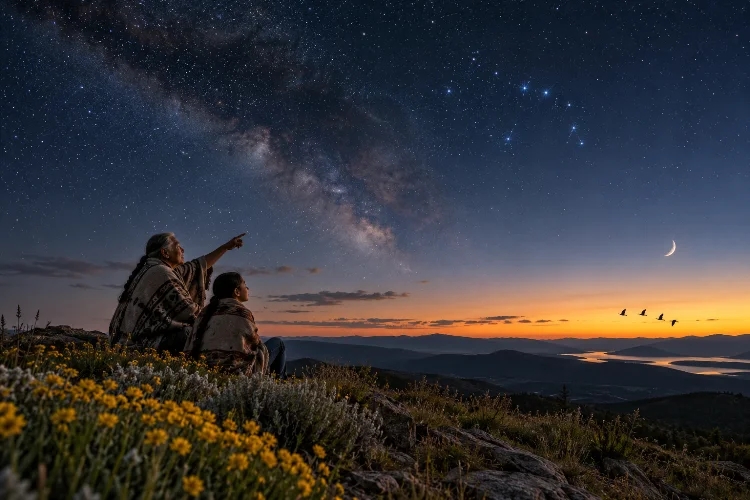
Imagine looking at the night sky without a printed calendar, weather app, GPS, or clock. A particular star appears before sunrise, the Moon reaches a familiar phase, birds begin migrating, and a certain plant starts flowering.
Together, these signs can tell a knowledgeable observer that an important season has arrived. This is the world of Indigenous astronomical knowledge and seasonal calendars.
Across many Indigenous communities, astronomy has never existed as an isolated study of stars. Observations of the Sun, Moon, planets, constellations, winds, tides, animals, and plants can work together as practical systems for understanding time and place.
These systems may guide fishing, planting, harvesting, hunting, travel, ceremony, and community gatherings. They also carry stories, language, spiritual teachings, and knowledge about ancestral landscapes.
Importantly, there is no single “Indigenous calendar.” Each community develops knowledge in relation to its own environment and cultural traditions.
Exploring these systems shows that the sky can function as far more than a map of distant objects. It can become a calendar, compass, archive, and cultural teacher.
Seasonal Calendars Read the Whole Environment
Western calendars divide the year into fixed months and usually four seasons. Many Indigenous seasonal systems work differently.
Instead of assuming that a season begins on a specific date, communities may recognize changes through combinations of environmental indicators.
Australia provides excellent examples.
CSIRO explains that Aboriginal and Torres Strait Islander seasonal knowledge can combine observations of plants, animals, weather, water, fire, and stars.
These indicators can show when foods are available, when animals are breeding, or when particular land-management activities should occur.
The number of seasons can also vary dramatically.
The Bureau of Meteorology documents calendars with two, three, four, five, six, or even more locally recognized seasonal periods. These systems reflect Australia’s enormous ecological diversity rather than forcing every landscape into the same four-season model.
The calendar is therefore less like a grid of dates and more like a network of relationships.
Stars Can Signal When a Season Is Changing
The sky provides especially reliable patterns because many celestial events repeat at predictable times.
A star appearing in a particular position before dawn can therefore act as a seasonal indicator.
The Kaurna seasonal calendar from the Adelaide Plains shows how astronomical and environmental observations can work together.
During Wirltuti, roughly corresponding with October to December, the position of the Southern Cross is one indicator of seasonal change. Other signs include warmer conditions, winds, thunder, lightning, and changes in plants and animals.
This combination is important.
The stars do not replace ecological observation. Instead, celestial and terrestrial indicators reinforce one another.
A knowledgeable observer might notice a constellation shifting, a bird beginning to nest, temperatures changing, and certain foods becoming available.
Together, those signals tell a much richer seasonal story than a date printed on a calendar.
Māori Matariki Connects the Stars With a New Year
In Aotearoa New Zealand, Matariki offers one of the best-known examples of astronomy shaping cultural time.
Matariki is the Māori name for the star cluster also widely known as the Pleiades. For many iwi, its pre-dawn appearance during winter is associated with the beginning of the Māori New Year.
However, traditions vary between iwi.
Te Papa explains that Māori timekeeping can consider the Sun, Moon, stars, and ecological indicators together. Some communities use Matariki, while others place greater importance on Puanga or other celestial signs.
Matariki is also connected with remembrance, food, environmental conditions, and hopes for the coming year.
Different stars within the Matariki cluster are associated in contemporary Māori teaching with freshwater, the ocean, rainfall, wind, cultivated food, wild food, wellbeing, and remembrance of people who have died.
Astronomy therefore becomes inseparable from relationships between people and the environment.
The Maramataka Links Moon Phases With Daily Activities
Māori seasonal knowledge also includes the maramataka, often described as a lunar calendar or environmental almanac.
Rather than simply counting months, maramataka traditions connect lunar phases with activities such as fishing, planting, harvesting, and other community practices.
Te Papa explains that Māori communities historically observed the Moon throughout its monthly cycle, while the beginning of months could also be aligned with the rising of particular stars.
A traditional year commonly contained 12 lunar months, although regional systems differed.
This illustrates why “astronomy” can be too narrow a word.
The Moon’s appearance matters because it is connected with tides, food gathering, seasons, and social activity.
Knowing the sky therefore means knowing when particular actions may be appropriate.
The maramataka becomes both celestial knowlege and practical environmental knowledge.
Torres Strait Calendars Connect Stars With Sea Country
Island communities may read the sky alongside an equally detailed understanding of the ocean.
The Erubam Le seasonal calendar from Erub in the Torres Strait combines stars with winds, clouds, marine life, animals, and plants.
The Bureau of Meteorology explains that Erub Kerker identifies four main seasons and uses patterns in animal movement, flowering and fruiting, sea life, star positions, cloud formations, and weather to understand when different resources are available.
This system demonstrates how seasonal astronomy adapts to local geography.
For an island community, knowing when winds change or marine species move may be more useful than following calendar categories developed in a distant temperate climate.
Knowledge of the sky is therefore embedded within Sea Country.
Stars may provide timing, but waves, clouds, fish, winds, and plants complete the picture.
Polynesian Wayfinding Used the Sky as a Compass
Astronomical knowledge is not only about knowing when something happens. It can also help determine where you are going.
Traditional Polynesian navigators crossed huge areas of the Pacific without GPS or modern navigational instruments.
Smithsonian material describes Polynesian wayfinding as a system based on observing celestial bodies, ocean currents, and other patterns in nature. Traditional navigators learned how stars could help maintain direction across open water.
A star does not remain in the same place all night, so navigation requires more than memorizing one bright object.
Navigators learn sequences of rising and setting stars, along with wave patterns, winds, birds, clouds, and other environmental clues.
Modern educational resources on traditional Hawaiian navigation also describe the use of a star compass, which organizes knowledge of where celestial objects rise and set around the horizon.
This shows how astronomical observation can become a highly practical technology – one stored in trained human memory rather than electronic equipment.
Stories Help Preserve Astronomical Knowledge
The night sky is easier to remember when it contains stories.
Many Indigenous astronomical traditions connect stars and constellations with ancestors, animals, creation narratives, moral teachings, or memorable events.
Storytelling can serve several functions simultaneously.
A story may explain relationships within a community’s worldview while also helping listeners remember where a celestial object appears, when it becomes visible, or what its appearance signals.
The Bureau of Meteorology notes that Aboriginal and Torres Strait Islander weather and environmental knowledge has been transmitted across generations through storytelling and ceremony.
This means oral tradition should not be dismissed as entertainment separate from observation.
Stories can become mnemonic systems.
A young person learning a narrative about the sky may also be learning directions, seasons, animal behavior, geography, or appropriate times for gathering resources.
Cultural memory and practical knowledge reinforce each other.
Seasonal Knowledge Is Local, Not Universal
One of the biggest mistakes when discussing Indigenous astronomy is treating knowledge from one community as representative of everyone.
It is not.
Even neighboring communities may organize seasons differently because landscapes, languages, cultural histories, and ecological relationships vary.
CSIRO emphasizes that Indigenous seasonal knowledge in Australia is highly localized and unique to language groups. The timing, number, and definition of seasons can differ substantially from one place to another.
Māori traditions show similar regional variation.
Not every iwi marks the New Year through exactly the same stars, and local visibility can affect whether Matariki or another celestial marker becomes important.
That variation is not inconsistency.
It demonstrates how carefully traditonal knowledge responds to place.
A useful seasonal system must fit the landscape where people actually live.
Astronomical Knowledge Supports Cultural Continuity
Learning the sky can also strengthen cultural identity.
When elders teach younger people how to recognize stars, Moon phases, weather patterns, plants, or seasonal changes, they often teach language and cultural values at the same time.
CSIRO notes that documenting seasonal calendars can help strengthen knowledge sharing between older and younger generations while demonstrating continuing connections with Country.
Matariki provides a powerful modern example.
The celebration has undergone major cultural revitalization in Aotearoa New Zealand and became a national public holiday in 2022. Yet its contemporary revival continues to emphasize Māori astronomical and environmental knowledge rather than separating the stars from culture.
Knowledge survives best when people use it.
A seasonal calendar displayed in a museum can preserve information, but a comunity observing the sky, harvesting food, speaking its language, and teaching younger generations keeps that knowledge living.
Climate Change Makes Seasonal Observation Even More Important
Seasonal systems are based partly on repeating environmental relationships.
Climate change can disturb those patterns.
Flowering may occur earlier, animal migrations may shift, rainfall can become less predictable, and familiar relationships between celestial markers and ecological events may change.
This does not necessarily make Indigenous seasonal knowledge obsolete.
In fact, observational systems can be valuable precisely because they pay close attention to local changes rather than assuming seasons always begin on fixed dates.
CSIRO’s seasonal calendar work emphasizes detailed observation of interactions among climate, water, plants, animals, fire, and other environmental factors.
At the same time, climate disruption creates cultural challenges.
If an environmental indicator no longer occurs when expected, communities may need to adapt inherited knowledge to new conditions.
Indigenous calendars have never been static. They are living knowledge systems built through observation – and continued observation remains essential.
Indigenous astronomical knowledge reveals that the sky can function as a calendar, compass, environmental guide, and cultural archive all at once.
Kaurna seasonal indicators connect constellations with plants and weather. Māori Matariki and maramataka traditions link stars and lunar phases with food, remembrance, and the yearly cycle.
Torres Strait knowledge combines celestial observation with marine environments, while Polynesian wayfinding demonstrates how stars can guide travel across vast oceans.
These traditions are diverse because they belong to particular places and communities.
Understanding them requires looking beyond constellations alone. Stars gain practical meaning through their relationships with weather, animals, plants, tides, language, and stories.
To explore Indigenous astronomy more deeply, start with the community and landscape behind the sky knowledge. That is where celestial observation becomes a living cultural system.