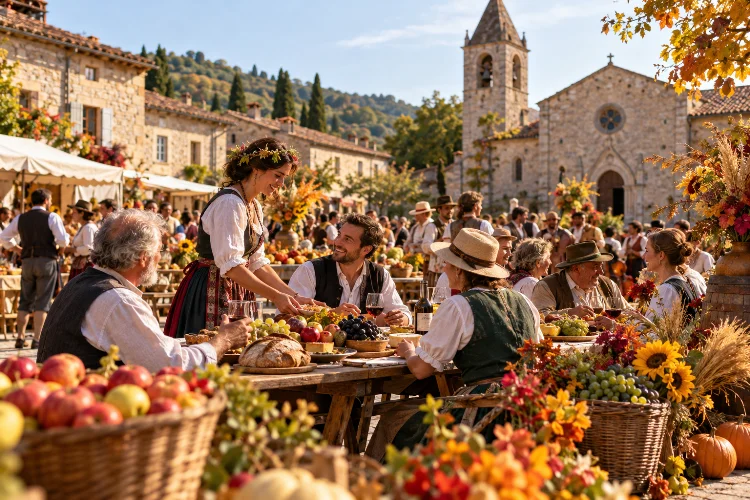
Picture a small European village at the end of summer. Tractors return from the fields, baskets are filled with apples or grapes, church interiors are decorated with produce, and neighbors gather around long tables to eat food grown only a few kilometers away.
For centuries, moments like these have marked one of the most important points in rural life: the harvest.
Harvest festivals across rural European communities developed because bringing crops safely from field to storage was never something farmers could take for granted.
Weather, pests, disease, and poor growing conditions could turn an entire year’s work into disappointment. A successful harvest therefore deserved celebration.
Yet these festivals are about more than agriculture. They combine religious thanksgiving, local foods, folk music, village cooperation, seasonal markets, and memories of older farming practices.
From British church harvest services and Polish Dożynki to German wine celebrations and Italian grape festivals, communities developed distinctive ways of saying essentially the same thing: the fields have provided again, and that achievement should be shared.
Harvest Once Determined the Rhythm of Rural Life
Before supermarkets and global food supply chains, the success of a local harvest directly affected how comfortably a community could survive the coming winter.
Grain needed to be gathered and dried. Fruit had to be preserved. Grapes were pressed, livestock prepared for colder months, and root vegetables stored carefully.
Finishing the harvest therefore represented relief.
It was also a social achievement. Before widespread agricultural mechanization, bringing crops in could require large groups of laborers working intensely for days or weeks.
When the final field was completed, everyone involved had a reason to celebrate.
This helps explain the old British tradition of the harvest supper. Farmers traditionally hosted meals for people who had helped gather crops, turning agricultural labor into a communal celebration.
England’s countryside charity CPRE notes that these suppers brought workers together to thank them for completing the growing year.
The harvest meal was effectively both payment in hospitality and recognition of shared effort.
British Harvest Festivals Blended Farming and Christian Thanksgiving
Britain has a long history of seasonal agricultural customs.
Earlier celebrations included Lammas, traditionally observed around August 1 and associated with the first grain harvest. The name is usually explained as “loaf mass,” reflecting the practice of making bread from newly harvested wheat.
The modern church-centered Harvest Festival became especially popular during the nineteenth century.
The Church of England traces an important turning point to Reverend Robert Stephen Hawker, who organized a harvest thanksgiving service in Cornwall in 1843. The annual celebration spread quickly and received official Church of England recognition in 1862.
Churches became decorated with wheat, apples, vegetables, flowers, and freshly baked bread.
In rural villages, religion and the farming calendar overlapped naturally. Thanksgiving for food was also thanksgiving for favorable growing conditions and the work of agricultural families.
Modern celebrations have changed somewhat.
Many British churches now donate harvested produce or packaged food to charities and food banks, connecting an older agricultural traditon with contemporary concerns about food insecurity.
Polish Dożynki Celebrates Farmers as Well as the Harvest
In Poland, one of the most recognizable harvest traditions is Dożynki.
The festival traditionally marks the completion of agricultural work and expresses gratitude for crops gathered during the year.
Modern Dożynki celebrations commonly feature elaborate harvest wreaths, folk costumes, music, regional food, religious services, and processions.
At the Polish Harvest Festival held in Spała in September 2026, celebrations began with an outdoor Mass followed by a procession.
Delegations brought traditional harvest wreaths, while regional foods, crafts, and folk performances highlighted different parts of Polish rural culture.
The wreath is particularly meaningful.
Traditionally created from grain, flowers, herbs, and other agricultural materials, it visually transforms the harvest into a symbol of abundance.
Dożynki also highlights something easily overlooked in discussions of harvest festivals: the farmer.
The festival does not simply celebrate grain or vegetables. It publicly recognizes the people whose labor produces them.
Poland’s Ministry of Agriculture describes contemporary Dożynki as both gratitude for the harvest and a celebration that brings communities together around farming and Polish folk culture.
German Wine Festivals Turn the Grape Harvest Into Local Identity
Not every harvest festival revolves around grain.
In Germany’s wine-producing regions, autumn is closely connected with the grape harvest, or Weinlese.
Regions such as the Palatinate, Rheingau, Rheinhessen, Franconia, Moselle, and Baden have landscapes and local economies shaped by vineyards.
When grapes ripen, harvest becomes cultural as well as agricultural.
Germany’s national tourism organization notes that seasonal wine festivals are held across the country’s wine-growing regions, some with traditions extending for centuries. The grape harvest itself is widely celebrated with festivals, local foods, music, and regional wines.
These events reveal how crops can shape local identity.
A village known for Riesling does not experience harvest in exactly the same way as a community surrounded by wheat fields or apple orchards.
Local foods reinforce that connection.
Fresh young wine known as Federweißer, for example, is traditionally paired with onion tart in some German wine regions. Seasonal dishes turn agricultural timing into something people can literally taste.
The agricultural calendar becomes a culinary calendar too.
Italian Grape Festivals Preserve the Culture of Vendemmia
Travel south into rural Italy and harvest culture changes again.
In wine-producing areas, vendemmia, the grape harvest, remains one of the most culturally recognizable stages of the farming year.
Some villages celebrate it through festivals known as sagre, where food, music, wine, parades, and local traditions fill streets and squares.
Cupramontana in the Marche region provides a vivid example.
Its annual Sagra dell’Uva began in 1928 and has developed into one of the region’s best-known grape harvest festivals. Contemporary celebrations feature folk traditions, local cuisine, music, decorated harvest floats, and even competitions recreating traditional grape stomping.
Another festival in Montefelcino explicitly celebrates the connection between grape harvest, village life, local wine, and countryside customs.
These events demonstrate how a practical farming activity can become heritage.
Most visitors no longer need to crush grapes with their feet, but recreating the practice allows communities to remember how earlier generations worked.
The festival keeps an older agricultural world visible even as technology changes the real harvest.
Harvest Foods Function Like Edible Local History
Food may be the easiest part of harvest culture to preserve.
A village can lose older farming tools or replace manual labor with machinery while still preparing the same seasonal dishes every autumn.
Across Europe, harvest foods often reflect what grows nearby.
Wine regions serve new wine. Orchard areas celebrate apples and plums. Grain-growing communities bake bread. Pumpkins, mushrooms, chestnuts, cabbage, game, and preserved foods appear according to local climate.
Germany’s tourism board highlights how autumn celebrations follow local produce, from apples and chestnuts to pumpkins, grapes, and freshly made wine.
Food therefore preserves geography.
Recipes tell you what farmers historically grew, what ripened at a certain time, and what could be stored for winter.
They also preserve family memory.
Someone may no longer work on a farm but still associate a particular cake, bread, soup, or wine with grandparents and childhood harvest gatherings.
Through taste, the agricultural past survives.
Folk Customs Preserve Community Memory
Music, clothing, wreaths, dances, processions, and agricultural displays may look decorative to visitors, but they often carry historical information.
Traditional songs may describe working in the fields.
Harvest wreaths preserve knowledge of local grains and plants. Parades recreate old methods of transportation or farm labor.
In this way, festivals work almost like living museums.
The difference is that people are participating rather than simply looking through a glass display.
A child helping create a Polish harvest wreath or joining an Italian grape festival learns cultural knowledge through experience.
That transmission helps explain why these celebratons remain important even when agriculture employs a much smaller percentage of the population.
Their role gradually shifts from celebrating survival after harvest to preserving rural identity.
Modern Festivals Connect Farming With Tourism
Contemporary European harvest festivals often perform another function: supporting rural economies.
Visitors travel to villages for wine tastings, regional cuisine, farm markets, music, craft displays, and opportunities to experience the countryside.
For small communities, that attention can create valuable income.
Germany actively promotes autumn travel around vineyards, orchards, wine festivals, and harvest experiences. Italy similarly uses village grape festivals to highlight local food, wine, and rural destinations.
There is an interesting balance here.
Tourism can help keep traditions economically viable, but festivals risk becoming detached from their agricultural roots if they turn entirely into entertainment.
The strongest events usually maintain some clear connection with farmers, local crops, traditional knowledge, and seasonal timing.
That connection makes a harvest festival feel different from an ordinary food fair.
Harvest Celebrations Still Build Community
Agricultural technology has transformed European farming.
Combine harvesters can perform work that once required large groups of people. Refrigeration and global trade mean consumers are less dependent on strictly local seasonal food.
Yet harvest celebrations continue.
Why?
Partly because they provide something modern agriculture cannot mechanize: community recognition.
A harvest festival allows villages to acknowledge farmers, gather families, preserve music and food traditions, and remind residents that landscapes are shaped by human work.
The Polish government describes Dożynki as a tradition that brings people together around agriculture and rural culture.
Traditional British harvest suppers historically performed a similar social function, while Mediterranean wine festivals continue to gather communities around crops that define their regions.
The machines have changed.
The need to celebrate together has not.
Harvest festivals across rural European communities reveal how strongly agriculture has shaped culture, religion, food, and local identity.
British villages transformed harvest thanksgiving into church services and communal meals. Polish Dożynki combines wreaths, processions, faith, and appreciation for farmers.
German wine regions celebrate autumn through vineyards and seasonal cuisine, while Italian grape festivals preserve the traditions of vendemmia.
Today, these festivals no longer depend entirely on manual farming, but their cultural role remains important.
They remind communities where food comes from and preserve memories of rural life that might otherwise disappear.
If you want to understand a European village beyond its architecture or tourist attractions, visit during harvest season. The food, music, fields, and local traditions often tell its story better than any guidebook.