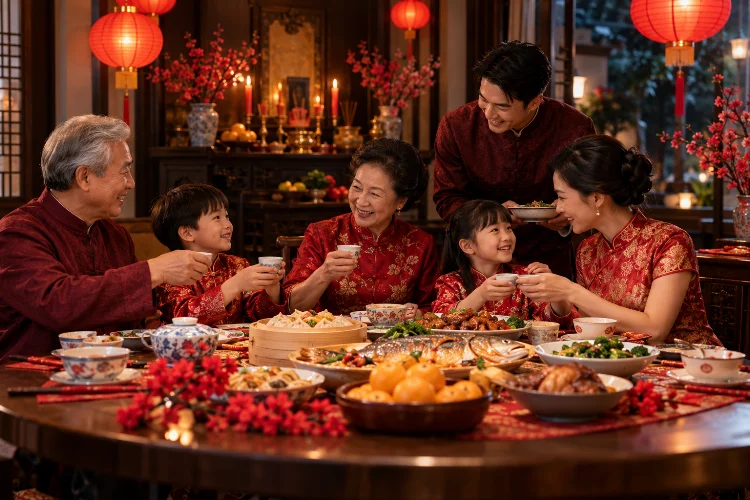
A new year does not have to begin on January 1.
Across parts of East and Southeast Asia, generations of families have welcomed a new cycle according to traditional lunisolar calendars, often with reunion dinners, ancestor rituals, new clothes, festive foods, decorations, and wishes for prosperity.
Understanding the cultural origins of Lunar New Year celebrations means looking beyond fireworks and zodiac animals.
The festival developed through a complex mixture of agricultural rhythms, calendar systems, religious beliefs, family traditions, and ideas about renewal.
China’s Spring Festival is perhaps the best-known example, but Lunar New Year is not simply one identical holiday celebrated everywhere.
Korea’s Seollal and Vietnam’s Tết have their own histories, foods, rituals, and cultural meanings. Other Asian communities maintain still different New Year traditions.
What connects many of these celebrations is the idea of transition: finishing the old year properly and entering the new one with good relationships, good fortune, and renewed social bonds.
That combination has kept Lunar New Year meaningful for centuries.
The Lunisolar Calendar Shaped the Timing of the Festival
The term “Lunar New Year” can be slightly misleading because many traditional calendars involved are lunisolar, not purely lunar.
A lunisolar calendar tracks months according to phases of the moon while also making adjustments to keep the calendar aligned with the solar year and changing seasons.
This is why the festival moves around on the modern Gregorian calendar rather than falling on the same date each year.
The Smithsonian’s National Museum of Asian Art describes Lunar New Year as marking both the arrival of spring and the beginning of a new year in the lunisolar calendar. It is widely celebrated in China, Korea, Vietnam, and communities throughout the Asian diaspora.
In China, the holiday became closely associated with the Spring Festival.
This seasonal connection matters because traditional societies depended heavily on farming. Starting a new yearly cycle near the transition toward spring naturally encouraged hopes for fertility, favorable weather, and future abundance.
The calendar therefore connected astronomical observation with everyday survival.
Agricultural Life Helped Shape New Year Traditions
Before industrialization, agricultural cycles strongly influenced how people understood time.
Winter represented a relatively quiet period in many farming communities, while the approach of spring signaled renewed activity. Preparing for a new agricultural year made the season a natural moment for household cleaning, food preparation, ritual observance, and celebrations of renewal.
The National Museum of Asian Art specifically notes that the Chinese Spring Festival traditionally marks the beginning of the agricultural season.
That agricultural background helps explain why wishes for prosperity and abundance appear so frequently.
Families were not simply hoping to become richer in an abstract sense. Historically, prosperity could mean sufficient grain, healthy livestock, successful harvests, and enough resources to support the household through another year.
Seasonal foods also reflected this connection.
Ingredients available around the holiday became attached to symbolic meanings, gradually transforming ordinary food into ritual food.
The agricutural calendar therefore provided the practical foundation on which many later customs developed.
Ancestor Veneration Connected the New Year With Family History
Lunar New Year is strongly associated with living relatives, but in many traditions the family extends symbolically to previous generations.
Ancestor remembrance has historically played an important role in Chinese New Year customs. Families may make offerings, visit ancestral graves or shrines, and acknowledge deceased relatives as part of the larger family community.
UNESCO’s description of China’s Spring Festival notes practices that include making offerings to ancestors alongside gatherings with elders, relatives, neighbors, and friends.
The message is powerful: beginning a new year is not only about looking forward.
It also means remembering where the family came from.
Ancestor traditions reinforce genealogical continuity. Children observe parents and grandparents performing rituals, hear family stories, and gradually learn their position within a multigenerational household.
This helps explain why Lunar New Year can remain emotionally significant even when people move far from their ancestral hometowns.
The celebration recreates family continuity wherever the family happens to live.
Reunion Dinners Turn Food Into Cultural Memory
One of the most recognizable Lunar New Year traditions is the family reunion meal.
In Chinese Spring Festival celebrations, New Year’s Eve dinner is often one of the most important moments of the entire holiday. The National Museum of Asian Art notes that dishes are frequently selected for symbolic associations, such as whole fish representing abundance.
Food symbolism often relies on language, appearance, shape, or traditional associations.
Dumplings may be linked with wealth because their shape resembles historical forms of currency. Long noodles can represent longevity, while round foods may suggest completeness or family unity.
Yet the social meaning of the meal may be even more important than individual symbols.
Relatives who live far apart return home, prepare familiar recipes, and sit at the same table. The food connects generations because many dishes are learned within families rather than simply taken from cookbooks.
A recipe can therefore become a form of cultural memory.
People may change jobs, cities, or countries, but the taste and preparation of a New Year dish can instantly reconnect them with childhood and family identity.
Cleaning and New Clothes Symbolize a Fresh Beginning
Preparation for Lunar New Year traditionally begins before New Year’s Day.
Homes may be cleaned thoroughly, food stocked, decorations prepared, and debts or unfinished responsibilities addressed where possible.
UNESCO describes cleaning the home and preparing provisions as important practices before China’s Spring Festival.
Cleaning carries both practical and symbolic meanings.
A tidy house physically prepares for visiting relatives and guests, but it can also represent leaving behind the disorder or misfortune associated with the previous year.
New clothing communicates a similar idea.
Starting the year in something fresh creates a visible marker of renewal. Red decorations are especially prominent in many Chinese traditions because the color is associated with auspiciousness, happiness, and protection.
Together, these customs transform New Year into a ritual boundary.
Life before the festival belongs to the old cycle. Cleaning, decorating, dressing, and feasting create a symbolic passage into the next one.
Popular Legends Added New Layers to the Celebration
Folklore has also shaped how Lunar New Year is explained and remembered.
One famous story concerns Nian, a dangerous creature said to emerge around the New Year. According to popular versions of the legend, people discovered that loud noises, bright lights, and the color red could frighten the creature away.
The story is often used today to explain firecrackers and red decorations.
However, such legends should not be treated as simple historical records of how the festival originally began. New Year customs developed over long periods, and folklore frequently offers symbolic explanations for practices that may have more complicated historical origins.
This distinction makes the tradition more interesting, not less.
Legends show how communities explain customs to younger generations.
A child does not need to study ancient calendrical systems to understand a story about frightening away a monster. Stories make complicated traditions memorable and help transmit them.
Folklore therefore becomes another form of cultural preservation.
Lunar New Year Is Not One Single Asian Tradition
One of the most important things to understand is that “Lunar New Year” is an umbrella term.
China’s Spring Festival, Korea’s Seollal, and Vietnam’s Tết Nguyên Đán share certain broad patterns but are not interchangeable holidays.
The Smithsonian notes that celebrations vary by culture even though family gatherings, symbolic foods, and household preparations appear across several traditions.
Vietnamese Tết, for example, places strong emphasis on family visits, seasonal foods, ancestral respect, and welcoming good fortune.
Smithsonian archival material describes Tết celebrations involving family gatherings, festive foods, decorations, firecrackers, and lion or dragon dances.
Korean Seollal similarly centers heavily on family.
Traditional practices can include ancestral rites, bowing respectfully to elders, eating tteokguk rice-cake soup, and playing traditional games.
Even zodiac systems can vary. Smithsonian resources note that some Vietnamese zodiac traditions use the cat where the Chinese zodiac has the rabbit.
These differences remind us that cultural exchange does not produce identical traditions.
Each society adapted New Year celebrations to local history, beliefs, foods, and social structures.
Family Reunion Became One of the Festival’s Strongest Themes
Agricultural society has changed dramatically, but the emphasis on family remains.
Modern Lunar New Year celebrations can trigger enormous movements of people returning to hometowns. The Smithsonian describes China’s Spring Festival travel period, known as chunyun, as one of the world’s largest recurring human migrations.
That modern phenomenon reflects an older cultural principle.
The New Year is considered a time when family members should reconnect.
Visits to elders reinforce respect across generations. Children receive gifts or money in some traditions, while relatives exchange greetings designed to invite health, longevity, prosperity, or happiness.
UNESCO highlights precisely this role of China’s Spring Festival, describing it as a tradition that strengthens family values, social cohesion, identity, and cultural continuity.
In 2024, UNESCO added China’s Spring Festival social practices to the Representative List of the Intangible Cultural Heritage of Humanity.
The recognition reflects something families have understood for centuries: festivals survive because people keep practicing them together.
Global Migration Has Given Lunar New Year New Meanings
Today, Lunar New Year belongs to communities far beyond its historical Asian settings.
Chinese, Korean, Vietnamese, and other diasporic communities celebrate in cities around the world. Public parades, lion dances, food markets, cultural performances, and family gatherings allow traditions to survive far from ancestral homelands.
In these settings, the festival can take on an additional meaning: cultural identity.
Second- or third-generation families may use New Year celebrations to introduce younger relatives to language, food, music, stories, and family history.
Traditions also evolve.
Some customs become more public, others become simplified, and new foods or activities may appear as communities adapt to local environments.
That change does not automatically make the celebration less authentic.
Cultural traditions have always developed through adaptation.
What matters is the continuing ability of the festival to connect people with family, memory, renewal, and a shared sense of belonging.
The cultural origins of Lunar New Year celebrations are rooted in much more than a change of date.
Lunisolar calendars connected the New Year with seasonal change, agricultural traditions encouraged hopes for abundance, and ancestor rituals linked living families with previous generations.
Over centuries, reunion meals, cleaning customs, symbolic foods, decorations, folklore, and family visits added new layers of meaning.
At the same time, Lunar New Year should never be treated as one completely uniform Asian festival. Chinese Spring Festival, Korean Seollal, Vietnamese Tết, and other celebrations have distinct histories and traditions.
To understand Lunar New Year more deeply, explore the family customs behind the public spectacle. The food on the table, stories told by grandparents, and rituals repeated each year often reveal the festival’s richest cultural history.