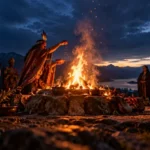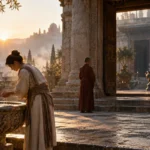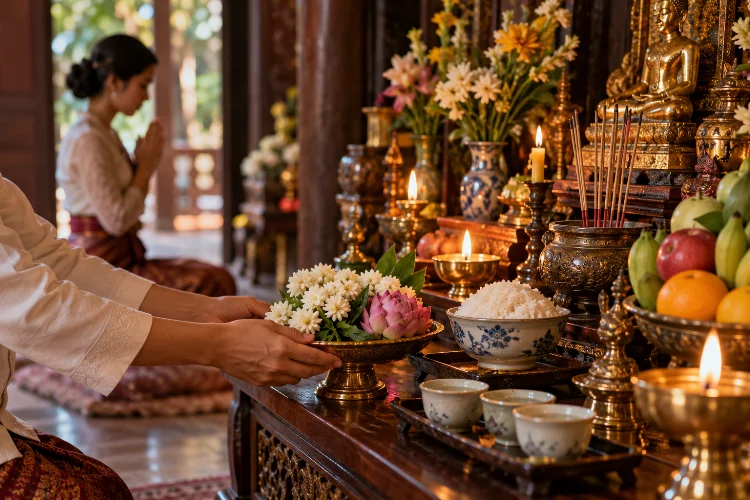
Place a bowl of rice in front of an ancestral shrine, leave flowers beside a sacred image, burn incense at a temple, or pour a small amount of liquid onto the ground.
From the outside, these actions may look simple. Within religious traditions, however, they can carry layers of meaning.
Ritual offerings in traditional religious practices have been used for thousands of years to express devotion, gratitude, remembrance, hospitality, obligation, and communication with sacred beings or ancestors.
The object being offered can vary enormously, from food and flowers to incense, precious objects, water, wine, lamps, or symbolic gifts.
Yet an offering is rarely meaningful simply because of the object itself. What matters is the relationship created through the act.
Different traditions also explain that relationship in very different ways. Some offerings honor deities as respected guests. Others maintain bonds with ancestors, generate religious merit, fulfill vows, or express thanks.
Looking closely at these practices reveals something important about religion: sometimes the act of giving can communicate ideas that words alone cannot fully express.
Ritual Offerings Are More Than Gifts
Calling every religious offering a “gift” can be helpful, but it can also oversimplify the practice.
A normal gift usually moves from one person to another. Sacred offerings may work differently.
Food might be presented before a deity and later shared by worshippers, incense may disappear entirely as smoke, or an object may be deliberately placed somewhere where humans will never use it again.
In some traditions, giving represents gratitude. Elsewhere, it expresses devotion, fulfills a vow, asks for assistance, honors ancestors, or helps establish communication between sacred and ordinary worlds.
The distinction between an offering and a sacrifice can also vary.
Sacrifice sometimes involves permanently surrendering or transforming something valuable, but not every offering involves destruction.
A flower placed before a sacred image and an animal sacrifice may both belong to religious systems of giving, yet their theological meanings can be very different.
Understanding the surrounding belief system is therefore more useful than simply asking what object was given.
Food Offerings Turn Hospitality Into Sacred Practice
Food is probably one of the most widespread forms of ritual offering.
That makes sense when we consider its everyday meaning. Sharing food creates relationships, welcomes guests, and demonstrates care. Religious traditions can extend those familiar social ideas into relationships with divine beings and ancestors.
Ancient Egyptian temple worship provides a striking example.
Priests presented food, beverages, and incense before divine images during daily temple rituals. Egyptians regarded temples as residences of deities, so providing food formed part of maintaining the god’s presence and cult.
After ritual presentation, provisions could circulate among temple personnel rather than simply being discarded.
Offerings also played an important role in funerary religion.
Middle Kingdom Egyptian offering tables were designed to receive food and liquid for the deceased. Some even contained carved images of provisions intended to provide symbolic nourishment if actual offerings eventually stopped.
Food therefore connected hospitality with eternal remembrance.
Hindu Puja Treats the Deity as an Honored Presence
In many forms of Hindu worship, giving takes on a particularly intimate character.
During puja, worshippers may present flowers, fruit, food, water, milk, incense, lamps, or other items before a divine image. The ritual can take place in a large temple or inside a household shrine.
The deity is not approached merely as a distant abstract concept.
Traditional worship can involve bathing, dressing, decorating, feeding, and entertaining divine images in ways comparable to receiving an honored guest.
The Metropolitan Museum of Art notes that Hindu worship includes flowers, food, water, milk, lamps, incense, chants, and other sensory elements.
A particularly interesting idea is prasad.
After something has been offered, worshippers may receive blessed food or another item back. The National Museum of Asian Art describes how a devotee may bring coconuts, bananas, flowers, or clothing and receive prasad from the temple priest.
Giving therefore becomes part of a relationship rather than a one-way transfer.
Incense Shows How an Offering Can Disappear Yet Remain Meaningful
Not all offerings are designed to remain physically visible.
Incense is transformed almost immediately.
Once lit, a solid material becomes fragrance and smoke. That physical transformation has made incense especially useful in religious environments where invisible presence, purification, prayer, or reverence plays an important role.
In ancient Egypt, incense was burned during temple rituals and was associated with purification.
In Buddhist traditions, incense can appear alongside lamps, food, flowers, water, music, and other devotional gifts.
At Himalayan Buddhist shrines, for example, Smithsonian’s National Museum of Asian Art describes offerings designed to engage multiple senses, including fragrant incense, glowing butter lamps, sweet foods, flowers, water, scarves, and ritual sculptures known as torma.
Such offerings can form part of merit-making and devotinal worship.
Here, the disappearance of the object is not a failure.
Transformation itself becomes part of the religious act.
Ancestor Offerings Keep Relationships Across Generations
Ritual giving is not always directed toward gods.
Many traditions use offerings to preserve relationships with deceased relatives or ancestors.
Ancient China provides especially strong archaeological evidence.
During the Shang period, elaborate bronze vessels were used to prepare or present food and drink during ancestral ceremonies. Some vessels were even inscribed with the names of ancestors connected with the rituals.
The famous bronze ding was among the most important vessel types. These cauldrons were used for preparing and serving food offerings, and their ownership eventually became associated with social rank and political authority.
This shows how ritual offering could do several things simultaneously.
It could honor ancestors, reinforce family identity, demonstrate elite status, and support political legitimacy.
Ancestor offerings also survive in many contemporary East Asian traditions. During Lunar New Year observances, for example, some families continue to present food and incense at ancestral shrines.
The offering keeps remberance active rather than leaving the dead entirely in the past.
Valuable Objects Can Become Offerings Through Surrender
Sometimes the importance of an offering comes from the fact that it is deliberately removed from normal human use.
Archaeologists studying ancient European religious sites have discovered weapons, jewelry, coins, pottery, and other valuables deposited in rivers, lakes, bogs, pits, or sacred environments.
In ancient Celtic contexts, votive offerings could include food, decorated weapons, jewelry, armor, pottery, and models associated with healing. Some valuable objects were intentionally bent or broken before deposition.
From a purely economic perspective, destroying a valuable sword seems wasteful.
Ritually, that may have been exactly the point.
An object that could no longer return to ordinary circulation had been permanently surrendered. The act demonstrated commitment because the giver lost access to something useful or prestigious.
This helps explain why religious value cannot always be measured through practical usefulness.
Sometimes giving becomes meaningful precisely because something valuable is no longer available to the giver.
Offerings Can Reinforce Social Identity and Hierarchy
Religious offerings may appear deeply personal, but they often communicate social information too.
Who can perform a ritual? Who provides the offering? Who prepares it? Who receives portions afterward? How elaborate should the gift be?
The answers can reveal social organization.
In ancient China, the number and type of bronze ritual vessels used by nobles became connected with rank. Possessing certain vessels therefore communicated both religious privilege and political status.
Large temple offerings in other societies similarly required agricultural production, specialized crafts, priests, administrators, and laborers.
A ceremony involving hundreds of loaves, jars of drink, flowers, incense, or animals was therefore not only spiritual. It could demonstrate the ability of an institution or ruler to mobilize resources.
Even small household offerings help construct identity.
Repeatedly preparing incense, flowers, food, lamps, or water teaches younger generations which sacred beings matter, how ceremonies should be performed, and what belonging to the comunity looks like.
The Meaning of an Offering Depends on Context
One of the easiest mistakes in studying religion is assuming that similar objects must have similar meanings.
Rice appears in many rituals. So do flowers, lamps, water, incense, and food.
But an offering of fruit before a Hindu deity cannot automatically be interpreted in the same way as food presented to an Egyptian god or provisions placed at an ancestral shrine.
The material may be similar while the worldview is different.
Some practices emphasize reciprocity. Others focus on hospitality, merit, gratitude, remembrance, purification, protection, fulfillment of vows, or maintaining relationships with ancestors.
Even within the same religion, meanings can vary according to region, historical period, deity, festival, and local tradition.
For that reason, ritual objects should always be studied together with prayers, sacred texts, oral traditions, locations, participants, and ceremonial sequence.
The context transforms an everyday object into something symbollic.
Ritual Giving Turns Belief Into Physical Action
One reason offering traditions remain powerful is that they make abstract beliefs tangible.
Gratitude becomes a flower.
Memory becomes a meal prepared for an ancestor.
Devotion becomes incense rising from an altar.
Hospitality becomes fruit placed before a deity.
These physical actions also make religious knowledge easier to pass between generations.
A child can learn where an offering is placed, how food is prepared, which incense is appropriate, or when a ceremony occurs long before understanding every theological explanation behind it.
Repeated actions gradually become cultural memory.
That is why offerings appear across so many religious environments. They allow people to express relationships with beings who cannot necessarily be interacted with through ordinary social behavior.
The gift becomes a bridge between visible action and invisible belief.
Ritual offerings reveal how deeply the act of giving can shape religious experience.
Food may express hospitality, incense can transform devotion into fragrance and smoke, valuable objects may demonstrate permanent surrender, and ancestral offerings can keep relationships alive across generations.
In other traditions, offerings create merit, fulfill obligations, express gratitude, or invite divine blessing.
What matters most is not simply the object on the altar.
Its meaning comes from the beliefs, relationships, rituals, and communities surrounding it.
Studying these practices therefore offers a fascinating way to understand traditional religions without reducing them to strange customs or symbolic objects.
Explore why something is offered, who gives it, and what happens afterward, and the deeper worldview behind the ceremony begins to emerge.