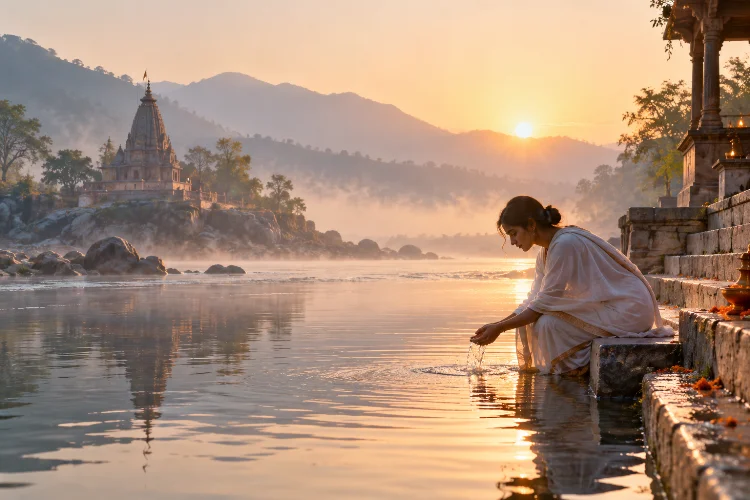
Water seems completely ordinary until it enters a sacred setting. A river becomes a pilgrimage destination, a small basin prepares someone for worship, and a few drops placed on the body can mark the beginning of an entirely new religious identity.
Across cultures, water symbolism across global spiritual traditions reveals how one natural element can carry remarkably different meanings.
Water may represent purification, rebirth, healing, divine blessing, transition, spiritual readiness, or even the boundary between ordinary and sacred life.
Its appeal is easy to understand. Water gives life, cleans the body, changes shape, flows across boundaries, and can be both peaceful and destructive. Religions have interpreted those physical qualities through their own beliefs and histories.
Yet similar practices should not be treated as identical. Christian baptism, Jewish mikveh immersion, Islamic wudu, Shinto purification, and Hindu sacred bathing all involve water, but their theological purposes differ significantly.
Exploring these differences helps us understand not only religious ceremonies, but also how human cultures transform everyday elements into powerful symbols of invisible spiritual ideas.
Why Water Became a Universal Religious Symbol
Every human community depends on water.
Without it, crops fail, animals die, and settlements cannot survive. Early civilizations therefore developed around rivers, springs, lakes, and reliable rainfall.
That practical importance naturally influenced symbolic thinking.
Water could represent life because life physically depended on it. Its ability to clean made it useful as an image of purification, while its flowing nature suggested movement and transformation.
At the same time, water could be dangerous.
Floods destroyed communities, storms sank ships, and deep water created environments humans could not easily control. This gave water another symbolic dimension: chaos, mystery, death, or forces larger than human beings.
Religious traditions developed different combinations of these meanings.
What makes water spiritually powerful is not simply the liquid itself. Meaning comes from the stories, rituals, sacred texts, communities, and places surrounding it.
Christian Baptism Connects Water With Rebirth
Christianity provides one of the world’s most familiar examples of sacred water through baptism.
The practice is closely connected with the baptism of Jesus by John the Baptist. Christian traditions later developed baptism as an important initiation into the faith.
Practices differ between denominations. Some churches baptize through full immersion, while others pour or sprinkle water over the person.
Despite these differences, baptism commonly communicates ideas involving entry into Christian life, cleansing, death and resurrection, and spiritual rebirth.
The Metropolitan Museum of Art describes baptism within Catholicism as a sacrament of rebirth expressed through washing or marking with water.
Water therefore marks more than physical cleaning.
Entering or receiving the water creates a visible transition between religious conditions. Something internal and spiritual is expressed through an external action that a comunity can witness.
That makes water especially effective in rites of initiation: transformation becomes physically recognizable.
Jewish Mikveh Shows the Difference Between Ritual and Physical Cleanliness
Jewish traditions demonstrate why sacred water should not automatically be interpreted as ordinary washing.
A mikveh is a ritual bath whose water must meet specific religious requirements. Traditional construction connects it with naturally occurring water, such as rainwater or a natural spring.
Immersion has historically been associated with ritual purification and is still used in several contexts, including conversion and observance of niddah in traditional Jewish communities.
Interestingly, a person normally cleans their body thoroughly before entering a contemporary mikveh.
That distinction is important.
If someone is already physically clean before immersion, then the purpose of the mikveh clearly goes beyond removing dirt. Ritual purity belongs to a religious category with its own rules and meanings.
Water becomes part of a transition between states rather than simply a cleaning technology.
This example also warns us against casually translating “purity” as moral goodness. In many religious traditions, ritual status and personal morality are separate concepts.
Wudu Turns Water Into Preparation for Prayer
In Islam, water frequently appears as part of preparation for worship.
Wudu, or minor ablution, involves prescribed washing or wiping of parts of the body before formal prayer when ritual purification is required. Qur’an 5:6 refers to washing the face and hands or arms and attending to the head and feet.
The precise details of practice can differ among Islamic legal traditions.
Wudu demonstrates how water can create a transition without requiring dramatic public ceremony.
Prayer happens repeatedly throughout everyday life, so ritual preparation can also become an ordinary rhythm. Washing provides a clear moment in which attention shifts away from routine activities and toward worship.
Yet the symbolism cannot be reduced to hygiene.
Islamic tradition also recognizes tayammum, a form of ritual purification using clean earth under circumstances where water cannot appropriately be used.
That possibility shows that the deeper issue is ritual readiness rather than simply becoming physically cleaner.
Water normally serves the practice because religious law gives the action meaning.
Shinto Purification Marks the Approach to Sacred Space
At Shinto shrines in Japan, visitors commonly encounter water before reaching the main place of worship.
A temizuya or chōzuya provides water for rinsing the hands and mouth. The Japan National Tourism Organization describes this practice as purification of body and mind before approaching the deity or kami.
The placement of the water pavilion is significant.
Visitors have already entered shrine grounds but have not yet performed the central act of prayer. Purification therefore occupies a transitional space.
The act helps seperate ordinary movement from sacred encounter.
Shinto traditions also include more intensive forms of water purification, often discussed under the broader idea of misogi, in which water can play a stronger role in ceremonial purification.
Here, water symbolism is closely connected with purity and appropriate preparation for encountering sacred presence.
The physical sequence matters: approach, purify, continue inward, and worship.
Sacred geography and ritual movement work together.
Hindu Sacred Rivers Connect Water With Liberation and Divine Presence
In Hindu traditions, water can become sacred not only because of what someone does with it but because of where the water comes from.
The River Ganges, or Ganga, is perhaps the most famous example.
For many Hindus, the Ganges is not merely an important geographical river. She is also understood as sacred and personified as the goddess Ganga.
Bathing in sacred waters can be associated with purification and liberation from sin.
This relationship becomes especially visible during Kumbh Mela, a major pilgrimage gathering where participants bathe in sacred rivers.
UNESCO describes Kumbh Mela as the world’s largest peaceful gathering of pilgrims and notes the belief that bathing in the Ganges can free devotees from sins and support liberation from the cycle of birth and death.
The ritual is therefore simultaneously personal and collective.
One individual enters the water, but millions may perform similar actions during the same religious gathering.
Water connects the body, sacred geography, mythology, pilgrimage, and comunal identity.
Sacred Water Can Represent Life as Well as Purification
Discussions of religious water symbolism often focus heavily on purification.
That is only part of the story.
Water also represents life, fertility, abundance, healing, and divine provision. These associations make sense in landscapes where reliable water determines whether communities survive.
Sacred springs, wells, rivers, and fountains have therefore attracted religious attention in many parts of the world.
The idea of “living water” appears within Jewish and Christian traditions, while sacred rivers in South Asia connect flowing water with divine presence and spiritual power.
Water also functions naturally as a metaphor for renewal because it continuously moves through the environment.
Rain falls, rivers flow, plants grow, water evaporates, and the cycle begins again.
For religious imagination, this cycle offers a powerful way to think about regeneration.
Something that appears exhausted can return. Something dry can become fertile again.
That physical reality makes water a natural simbolic language for spiritual restoration.
Water Often Marks Important Boundaries and Transitions
Many water rituals happen at moments when someone is moving from one state into another.
A convert enters a religious community. A worshipper prepares for prayer. A pilgrim approaches a sacred place. Someone returns from a state requiring ritual purification.
Anthropologists often describe rituals surrounding these changes as rites of passage or transitional ceremonies.
Water makes the boundary tangible.
Before the ritual, the person occupies one condition. Afterward, something has changed – at least within the worldview of the religious community.
This may help explain why immersion is especially dramatic.
A person temporarily disappears below the surface and emerges again. Without saying a word, the physical movement can suggest death and rebirth, separation and return, or the transition between religious states.
Other traditions need only a small amount of water.
Quantity is not what creates sacred meaning.
A handful of water at a shrine can be just as culturally meaningful as entering an entire river because the traditon surrounding the action determines its significance.
Similar Water Rituals Can Express Very Different Beliefs
Comparative religion becomes misleading when similarity is mistaken for sameness.
Christian baptism and Jewish mikveh both involve immersion in some traditions, yet they belong to different theological systems.
Wudu and Shinto temizu both involve washing before worship, but Islamic concepts of ritual purification are not interchangeable with Shinto ideas about purity and approaching kami.
Hindu bathing in a sacred river introduces yet another worldview by connecting ritual action with sacred geography, pilgrimage, divine presence, and liberation.
The physical element remains water.
Everything around it changes.
That is why cultural context matters so much.
Instead of asking simply, “What does water symbolize in religion?” a better question is, “What does water mean within this particular tradition, ceremony, and historical setting?”
That approach reveals far more about how spiritual symbols actually work.
Water carries extraordinary symbolic power because it is already essential to human existence. It sustains life, washes the body, transforms landscapes, crosses boundaries, and constantly changes form.
Religious traditions have turned those physical qualities into different spiritual languages.
Christian baptism can express initiation and rebirth. Jewish mikveh immersion changes ritual status, Islamic wudu prepares a worshipper for prayer, Shinto water rites mark an approach toward sacred space, and Hindu sacred bathing can connect pilgrimage with purification and liberation.
The similarity of water should not hide the diversity of meaning.
To understand sacred water more deeply, look beyond the action itself. Ask who performs it, where it happens, what beliefs surround it, and what changes afterward. Those details reveal how an everyday element becomes a bridge between physical experience and spiritual worldview.