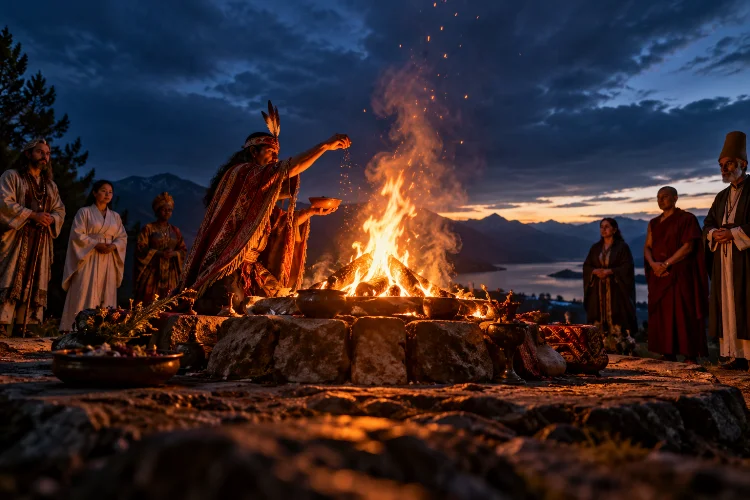
Fire is one of those things humans rarely experience as completely ordinary. It warms a home, cooks food, destroys forests, transforms materials, and can disappear almost instantly if it is not maintained. Those qualities have made it an unusually powerful religious symbol.
Across different cultures, sacred fire ceremonies have expressed ideas about divine presence, purification, sacrifice, transformation, community, and the structure of the universe. Yet similar-looking flames do not necessarily carry the same spiritual meaning.
In Vedic traditions, fire could carry offerings toward the gods. In Zoroastrianism, carefully protected fire became closely associated with truth, purity, and divine creation.
Japanese esoteric Buddhist traditions transformed older homa practices into rituals focused partly on overcoming spiritual obstacles. Ancient Mediterranean societies, meanwhile, linked the continuously burning hearth with family and civic continuity.
Comparing these traditions shows something important: ritual fire is not one universal religious language with a single definition. Instead, different societies used the physical qualities of flame to express very different ways of understanding humans, gods, morality, and the cosmos.
Why Fire Became Such a Powerful Spiritual Symbol
Fire naturally lends itself to religious interpretation because it transforms whatever enters it.
Wood becomes flame, smoke, heat, and ash. An offering placed in a ritual fire visibly changes form, making fire an effective symbol for communication between ordinary and sacred worlds.
Flame also combines qualities that appear contradictory. It provides warmth but can cause destruction. It illuminates darkness while consuming its fuel. It constantly moves yet can remain burning in the same location for generations.
Religious traditions interpret these characteristics differently.
Sometimes fire represents purification. Elsewhere it becomes a divine intermediary, an enduring sacred presence, or a force that destroys ignorance.
This variety is exactly why comparisons need to be careful. Seeing fire in two ceremonies does not mean the ceremonies express the same theology.
Vedic Fire Rituals Connected Humans With the Divine
Fire held an especially important position in early Vedic religion.
The deity Agni, associated with fire, acted as an intermediary through whom ritual offerings could reach other divine beings. In the Vedic yajna, materials were offered into a carefully prepared fire while priests recited sacred formulas.
Smarthistory describes Agni as the intermediary through whom Vedic deities were summoned and received ritual offerings.
This gives the flame a relational function.
The offering is not simply destroyed. Burning becomes part of an exchange connecting the human and divine realms.
The agnihotra, another ancient Vedic fire practice, developed around recurring offerings made into ritual fire. Variations of the practice survived for centuries and can still be found in parts of South Asia, including Nepal.
Within this worldview, fire can represent connection and cosmic order. Proper ritual action helps maintain relationships larger than the individual worshipper.
Zoroastrian Sacred Fire Represents Truth and Purity
Zoroastrianism offers a very different understanding of sacred flame.
It is sometimes casually described as “fire worship,” but that phrase can be misleading. Zoroastrians do not simply treat physical fire as a god. Fire carries profound religious significance as a pure creation associated with Asha, the principle of truth, order, and righteousness.
Encyclopaedia Iranica explains that ancient Iranian hearth fire developed strong spiritual importance and that Zoroaster connected fire with moral and cosmic ideas. Followers traditionally prayed in the presence of fire or another source of light.
Consecrated fires are maintained with considerable ritual care.
Different classifications of sacred fires developed, including the highly consecrated Atash Behram. Priests protect these fires from substances considered ritually contaminating and regularly offer clean wood and fragrance.
Here, continuity matters.
A flame carefully maintained over time becomes a simbolic focus for truth, purity, devotion, and the continuing life of a religious community.
Buddhist Goma Turns Fire Toward Inner Transformation
Fire sacrifice did not remain confined to Vedic religious contexts.
Versions of homa entered Buddhist traditions, particularly forms of Vajrayana and esoteric Buddhism. Over time, the practice traveled through Asia and developed into distinctive ritual systems.
In Japanese Shingon and Tendai Buddhism, it became known as goma.
During goma ceremonies, priests construct a ritual fire and place offerings into it while performing chants, visualizations, and other ceremonial actions.
One interpretation documented by Japan’s Tourism Agency describes the ritual flame as both carrying prayers and burning away attachments and desires associated with human suffering.
Academic research shows that Buddhist fire symbolism developed far beyond simply copying Vedic sacrifice. Fire could be connected with meditation, luminous consciousness, and the transformation of spiritual obstacles.
The worldview has shifted.
Instead of functioning only as a messenger carrying offerings outward, the flame can also symbolize transformtion within the practitioner.
Sacred Hearths Connected Fire With Home and Community
Not every sacred flame belonged to an elaborate sacrifice.
In ancient Greece, the domestic hearth carried strong religious and social meaning. Hestia, goddess of the hearth, represented the stability and unity of the household.
The idea extended beyond individual homes.
Greek communities maintained communal hearths, and fire from a mother city’s sacred hearth could be carried when establishing a new colony. In this way, the flame physically represented continuity between old and new communities.
Rome developed a related tradition around Vesta.
The Vestal Virgins were famously responsible for maintaining Rome’s sacred fire. Allowing it to go out was considered a serious religious failure because the flame was associated with the security and continuity of the Roman state.
These traditions reveal another worldview of sacred fire.
Rather than focusing mainly on spiritual purification or sacrificial communication, the continuing flame could embody social permanence.
As long as the fire survived, the household – or metaphorically the wider comunity – continued.
Burning Offerings Expresses More Than Destruction
One recurring feature of many fire ceremonies is the act of giving something to the flame.
That can easily look like destruction from an outside perspective. Yet religiously, burning may mean something very different.
In a Vedic context, the fire transforms offerings as part of communication with deities. In Buddhist goma, ritual offerings can become connected with removing obstacles or transforming attachments.
The physical act is similar, but the interpretation changes.
That distinction provides an important lesson for understanding ritual generally: actions receive meaning from the worldview surrounding them.
A bowl of grain, clarified butter, incense, wood, or a written prayer has no universal meaning simply because it enters a fire.
Its significance depends on who performs the ceremony, which texts or traditions guide it, what prayers accompany it, and what participants believe is happening.
Sacred Fire Can Represent Both Destruction and Renewal
Fire’s ability to destroy gives it another important spiritual quality.
Destruction does not always represent an ending. In many religious systems, removing something can create the conditions for renewal.
Hindu imagery provides a striking example beyond formal fire sacrifices.
In representations of Shiva Nataraja, Shiva holds agni, the flame associated with cosmic destruction. Yet Shiva’s dance represents a larger cycle that includes creation, preservation, destruction, and renewal.
Fire therefore becomes part of a cyclical understanding of existence.
Buddhist interpretations may turn destruction inward, with flames symbolically consuming ignorance or attachment.
Other traditions emphasize purification, suggesting that unwanted or ritually inappropriate elements can be removed so that proper order is restored.
The common image is fire, but the philosophies behind it remain distinct.
What Sacred Fire Reveals About Different Spiritual Worldviews
Comparing sacred fire traditions is useful precisely because they are not identical.
Vedic ritual can emphasize exchange and communication between humans and divine beings. Zoroastrian fire traditions connect flame with purity, truth, and sacred presence. Buddhist goma can focus on transformation and overcoming spiritual obstacles.
Greek and Roman hearth traditions demonstrate another possibility: fire representing continuity between household, ancestors, and political community.
These examples show how cultures use the same natural phenomenon to answer very different questions.
How can humans communicate with divine beings? What represents moral purity? How can attachment be overcome? What holds a comunity together? How does destruction lead to renewal?
Fire becomes meaningful because each traditon places it inside a larger spiritual explanation of reality.
Sacred fire ceremonies demonstrate how one natural element can express remarkably different understandings of the spiritual world.
Vedic traditions used fire as an intermediary connecting human offerings with divine beings. Zoroastrian communities developed sacred flames as powerful focuses of truth, purity, and religious continuity.
Buddhist goma transformed older fire practices into rituals associated with prayer and inner change, while Greek and Roman hearth traditions connected flame with household and civic identity.
The similarities are fascinating, but the differences matter even more.
Rather than assuming that sacred fire always symbolizes purification or sacrifice, look at the beliefs surrounding each ceremony.
Exploring those differences reveals how societies have used flame to make invisible ideas about divinity, morality, transformation, and belonging visible.