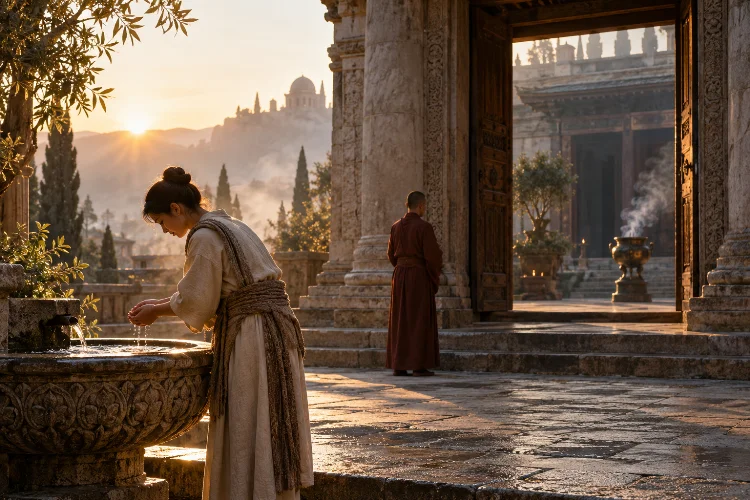
Washing your hands before entering a sacred place might look like an ordinary act. Step into its cultural context, however, and that simple movement can represent something much deeper: leaving everyday life behind and preparing to encounter the sacred.
Across history, ritual purification traditions have appeared in remarkably different societies. Water is probably the most familiar element, but purification has also involved smoke, fire, fasting, prayer, immersion, special clothing, and carefully structured ceremonies.
These practices should not be confused with ordinary hygiene. A person can be physically clean while still requiring ritual purification according to a particular religious tradition. Likewise, ritual purity does not automatically imply moral superiority or personal cleanliness.
Instead, purification often marks boundaries. It can signal that someone is ready to pray, enter sacred space, participate in a ceremony, begin a new stage of life, or return to a particular religious status.
Studying these traditions therefore reveals something larger than ceremonial washing. It shows how cultures use repeated physical actions to express invisible ideas about holiness, identity, order, transformation, and belonging.
Ritual Purification Is About Meaning, Not Just Cleanliness
The first thing to understand is that ritual purity and physical cleanliness are not necessarily the same thing.
In many religious systems, impurity is a specific ritual condition rather than a judgment that someone is dirty, sinful, or socially inferior. The rules defining that condition vary enormously between traditions.
A ritual may be required after particular bodily experiences, before prayer, before entering a sacred space, or during major transitions such as marriage or religious conversion.
This is why purification is better understood as a change of status.
Someone moves from one condition into another. The ritual creates a clear moment of seperation between ordinary activity and sacred participation.
Water works particularly well as a symbol because its physical ability to wash makes ideas of spiritual renewal easy to visualize. Yet the symbolic meaning ultimately comes from the cultural and theological system surrounding the action.
Water Creates a Boundary Between Everyday and Sacred Space
One of the strongest themes across purification traditions is preparation.
Before entering certain religious environments, worshippers perform actions that symbolically separate everyday life from sacred activity.
Japanese Shinto shrine visits provide a clear example.
Visitors commonly stop at a temizuya, or water pavilion, before approaching the shrine.
They rinse their hands and mouth with water, preparing body and mind before appearing before the kami. Japan’s official tourism organization describes the practice as purification performed before worship.
The location of the ritual matters.
It occurs between arrival and prayer, making purification part of the transition into sacred space.
Even the shrine entrance communicates a boundary. Passing through a torii gate symbolically marks movement toward an environment associated with the kami.
In this setting, water becomes more than a practical substance. It helps people mentally and physically shift from everyday activity toward respectful religious attention.
Wudu Turns Preparation for Prayer Into a Repeated Practice
In Islam, ritual purification is closely connected with prayer.
Wudu, or minor ablution, generally involves washing or wiping prescribed parts of the body before formal prayer when purification is required.
Qur’an 5:6 includes instructions involving the face, hands or arms, head, and feet, while details of practice can differ among schools of Islamic law.
Because Muslims normally pray several times each day, purification can become a regularly repeated part of religious life.
That repetition is culturally important.
Instead of spiritual preparation happening only during major festivals, it becomes woven into daily routine. Water, intention, bodily movement, and prayer follow one another in a recognizable sequence.
Islamic law also illustrates why ritual purification cannot simply be equated with hygiene. Under particular circumstances where water cannot appropriately be used, tayammum provides a ritual alternative involving clean earth or dust.
The goal is therefore not merely physical washing.
The deeper principle concerns readiness for worship and fulfillment of religious obligations.
Mikveh Shows How Immersion Can Mark a Change of Status
Jewish traditions provide another powerful example through the mikveh, a ritual immersion pool.
Historically, Jewish laws of ritual purity included numerous situations involving states of tumah and processes for returning to ritual purity. Immersion became an important form of purification in many circumstances.
Contemporary uses vary among Jewish communities.
Mikveh immersion remains especially associated with conversion to Judaism and, in traditional communities, with laws surrounding niddah. It may also be used before marriage or for other religious and spiritual purposes.
Again, the distinction between ritual and hygienic cleanliness is crucial.
Someone preparing to use a mikveh normally washes thoroughly beforehand. The immersion itself therefore performs a different cultural function from bathing.
Entering the water and emerging from it creates a visible transition.
That makes immersion particularly powerful as a simbolic act. The body crosses a boundary, providing a physical experience through which a new religious condition can be expressed.
Sacred Rivers Turn Purification Into a Collective Experience
Purification does not always take place privately.
Sometimes thousands—or even millions—of people participate in ritual bathing together.
The Hindu Kumbh Mela offers an extraordinary example. Pilgrims gather at sacred river locations in India, where bathing or immersion forms a central religious practice.
UNESCO inscribed Kumbh Mela on the Representative List of the Intangible Cultural Heritage of Humanity in 2017.
For devotees, bathing in sacred waters can be associated with purification from sins and hopes for spiritual liberation.
However, the cultural significance extends beyond the individual.
Kumbh Mela gathers ascetics, religious teachers, pilgrims, families, and visitors into an enormous temporary comunity. UNESCO describes the tradition as containing spiritual, ritual, social, and cultural customs passed through religious teaching, oral tradition, and historical texts.
This transforms purification into collective identity.
People are not only performing an individual ritual. They are joining a practice remembered and repeated across generations.
Purification Rituals Help People Navigate Life Transitions
Anthropologically, rituals are often particularly important when someone moves from one social condition into another.
Birth, adulthood, marriage, death, initiation, conversion, and periods of mourning can all create moments when ordinary categories seem temporarily unstable.
Purification provides structure.
The ceremony can communicate that one phase has ended and another is beginning. The person may wash, immerse, change clothes, fast, enter a special place, or follow particular restrictions before returning with a new status.
This pattern helps explain why purification appears so frequently around religious initiation.
The physical action creates a memorable experience of transformation.
Even when two traditions both use water, however, their meanings should not automatically be treated as identical. One may emphasize readiness for worship, another ritual status, another repentance, and another renewal.
Comparing purification traditions is most useful when we notice both the similarities and the differences.
Purity Rules Can Shape Social Boundaries
Ritual purification can also influence how communities organize people, spaces, objects, and time.
A sacred area may require preparation before entry. Certain religious objects may be handled only under specific conditions. Priests or ritual specialists may follow additional regulations connected with their roles.
Rules can therefore define boundaries between sacred and ordinary life.
Ancient religious traditions provide many examples. Greek and Roman worshippers used forms of ceremonial washing and lustration before particular sacrifices or encounters with sacred places.
Historical sources describe purification involving water as well as fire, sacrifice, and other substances.
These boundaries help societies answer practical cultural questions.
Who may enter this place? When is a person prepared for worship? Which actions restore ritual status? What separates ordinary time from ceremonial time?
The answers differ, but the questions reveal how purification can support larger systems of religious order.
Repetition Turns Purification Into Cultural Memory
A ritual becomes culturally powerful partly because people repeat it.
Children watch parents perform prescribed actions. Pilgrims see experienced worshippers follow familiar sequences. Religious specialists explain why particular gestures matter.
Eventually, the actions become part of communal memory.
Someone approaching a shrine water basin, preparing for prayer, entering a mikveh, or joining a ritual bath is participating in a traditon practiced by others before them.
The body becomes one of the ways culture remembers.
People may forget detailed theological explanations, yet still remember how to pour the water, where to stand, which prayer accompanies an action, or what must happen before entering sacred space.
This is why physical rituals can survive for remarkably long periods.
They turn abstract religious concepts into movements that can be demonstrated, copied, taught, and repeated.
Modern Life Continues to Reshape Purification Traditions
Purification practices are not archaeological leftovers.
Millions of people continue to perform them today, although interpretations and social contexts can change.
Modern plumbing, urbanization, travel, changing religious communities, and new debates about gender and accessibility have affected how some traditions are practiced.
Yet the underlying need for meaningful transitions remains familiar.
People still use rituals to create moments of preparation, reflection, renewal, and belonging. Even outside formal religion, modern societies frequently develop symbolic acts around beginnings and endings.
That does not mean secular routines are equivalent to religious purification.
Rather, it helps explain why ritual actions remain psychologically and culturally powerful. Humans often understand major changes more easily when abstract ideas are given a physical form.
Purification makes the invisible visible.
The cultural meaning of ritual purification goes far beyond washing away physical dirt.
Across different societies, purification can prepare worshippers for prayer, mark entry into sacred space, change ritual status, support spiritual renewal, and reinforce community identity.
Wudu, mikveh immersion, Shinto temizu, Hindu sacred bathing, and ancient lustration demonstrate how differently cultures can use physical actions to express relationships with the sacred.
What these traditions share is the ability to turn invisible ideas into memorable experiences involving the body, water, space, and repetition.
Understanding them also encourages more thoughtful cultural comparison. Instead of assuming every purification ritual means the same thing, explore the beliefs surrounding each practice. That is where the deeper story of religion, identity, and cultural tradition begins.