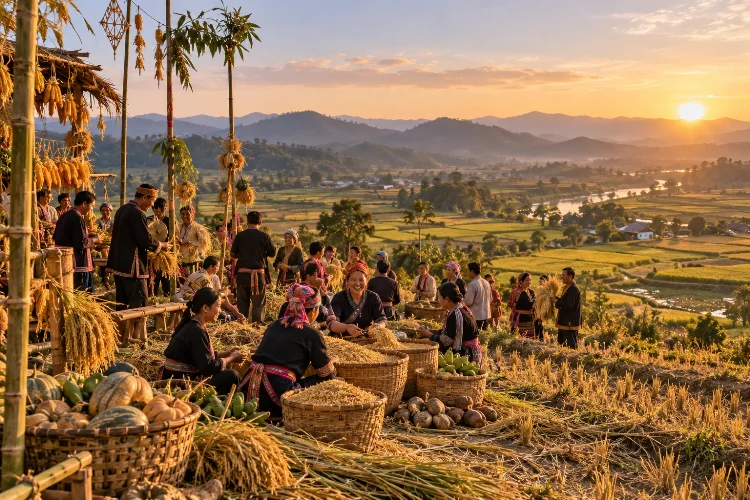
Long before weather apps and digital calendars told farmers when seasons were changing, communities watched the sky, rivers, plants, animals, and soil.
The agricultural year was measured through rainfall, planting, flowering, harvesting, and the arrival of particular seasonal conditions. Festivals grew naturally around these important moments.
Across the world, seasonal festivals and traditional agricultural calendars became closely connected because farming affected almost every part of community life. A successful harvest meant food, security, trade, and survival. A failed rainy season could create serious hardship.
Communities therefore developed ceremonies to welcome planting seasons, request favorable weather, celebrate the first crops, thank spiritual beings, and mark the end of harvest work.
These festivals were never only about farming. They could also reinforce religion, family relationships, local identity, music, food traditions, and historical memory.
From rice-transplanting ceremonies in Japan to harvest celebrations in South Asia and seasonal gatherings across Indigenous farming societies, festivals turned changes in the agricultural calendar into shared cultural experiences.
Agricultural Calendars Followed Nature Before They Followed Dates
Modern calendars divide the year into fixed months and numbered days. Traditional farming communities often needed a more flexible way to understand time.
Agricultural decisions depended on environmental signals.
The arrival of rain might indicate when fields should be prepared. Changes in temperature could signal planting or harvesting periods. The appearance of certain stars, birds, insects, or plants could also provide useful seasonal information.
This meant agricultural calendars were closely connected with local ecosystems.
The Food and Agriculture Organization describes traditional agricultural heritage systems as the result of communities gradually adapting their farming knowledge to particular environments.
These systems combine biodiversity, landscapes, local knowledge, livelihoods, and cultural practices.
A festival scheduled around planting or harvest therefore acted like a cultural marker in the farming year.
Instead of simply saying, “It is time to plant,” communities could announce the season through ceremonies, songs, gatherings, and shared meals.
Planting Festivals Mark the Beginning of Hope
Planting is one of the most uncertain stages of farming.
Seeds or seedlings are placed into the ground with no guarantee that rainfall, temperature, pests, or soil conditions will cooperate.
That uncertainty helps explain why planting seasons often attract ritual activity.
A fascinating example is Mibu no Hana Taue in Hiroshima Prefecture, Japan. The agricultural ritual is performed after rice transplanting and symbolically reenacts stages of preparing and planting a rice field.
Villagers decorate cattle, sing traditional songs, play instruments, and ceremonially transplant rice seedlings. UNESCO explains that the ritual is performed to honor the rice deity and seek an abundant harvest.
The ceremony transforms agricultural labor into cultural performance.
It also preserves knowledge. Younger participants observe how rice planting is represented, hear traditional music, and learn how farming connects with local religious identity.
The agricultural calendar becomes something people do together rather than something written on paper.
Harvest Festivals Celebrate the Moment Labor Becomes Food
If planting represents hope, harvest represents the moment months of labor finally produce visible results.
This is why harvest festivals appear in so many cultures.
Food naturally takes center stage. Communities may prepare dishes using newly harvested rice, grain, fruit, vegetables, or other seasonal crops.
The celebration can express relief as much as gratitude.
Historically, farming families depended heavily on the success of their crops. A good harvest improved the chances of surviving the coming season, while poor yields could threaten an entire comunity.
Traditional harvest celebrations therefore often combined practical and spiritual meaning.
Smithsonian material on agricultural folk traditions notes that many cultures historically marked harvest with gifts or symbolic practices connected with hopes for future abundance.
The celebration was not simply saying, “The work is finished.”
It also asked an important question: Will the land provide again next year?
Rice Cultures Developed Festivals Around the Entire Farming Cycle
Rice farming provides particularly clear examples of how festivals can follow agricultural stages.
Preparing a rice field, transplanting seedlings, maintaining irrigation, harvesting grain, and processing rice are all distinct activities.
Some communities created rituals around more than one of these stages.
The Oku-noto no Aenokoto tradition of Japan’s Noto Peninsula is especially interesting. Rice farmers perform ceremonies twice each year.
In December, after harvest, the farmer ceremonially welcomes the deity of the rice field into the home. A bath and meal are prepared for the invisible guest as an expression of gratitude.
A similar ceremony takes place before planting in February to ask for another successful crop.
UNESCO notes that the tradition has been passed between generations and functions as a marker of identity among local rice farmers.
This creates a circular understanding of agricultural time.
Harvest does not truly end the farming year. Gratitude for the previous crop gradually becomes preparation for the next one.
Festivals Help Communities Manage Seasonal Uncertainty
Agriculture has always involved risk.
Farmers can control how they prepare fields or select seeds, but they cannot completely control rainfall, drought, storms, insects, or unexpected temperature changes.
Ritual provides one way of culturally responding to that uncertainty.
Traditional ceremonies may appeal to deities, ancestors, spirits, or natural forces associated with fertility and abundance.
This should not be interpreted simply as farmers lacking practical agricultural knowledge.
Many traditional farming societies possessed detailed ecological knowledge built through generations of observation. Religious rituals existed alongside practical experience.
Ceremony addressed a different problem: the emotional and social uncertainty surrounding forces that people could not fully control.
The festival gave everyone something to do together.
People could pray, dance, make offerings, share food, or perform established customs. Even when the weather remained unpredictable, the community had a familiar cultural response.
Seasonal Celebrations Strengthen Community Identity
Agricultural work can involve individual households, but successful farming often depends on wider cooperation.
Planting, irrigation, harvesting, livestock management, and food processing can require many people working together.
Festivals reinforce those relationships.
UNESCO’s documentation of tugging rituals in rice-growing communities of Cambodia, the Philippines, South Korea, and Vietnam provides a good example.
These traditions are linked with hopes for abundant harvests and prosperity and commonly occur around the beginning of the agricultural cycle. UNESCO also emphasizes their role in strengthening solidarity and identity.
Festival activities create shared memory.
Someone may remember participating as a child, later return as an adult, and eventually teach the same ceremony to younger relatives.
Agriculture therefore becomes part of cultural inheritance.
People are not merely learning how to grow food. They are learning what their community values and how previous generations responded to the same seasonal rythms.
Traditional Foods Preserve the Agricultural Calendar
Festival foods can function almost like edible calendars.
A dish made from freshly harvested rice signals one season. New grain, seasonal fruits, milk, or vegetables may identify another.
This explains why many traditional celebrations feature ingredients strongly associated with local agriculture.
The meal tells participants what time of year they are experiencing.
Food also transforms agricultural production into cultural meaning.
Rice is no longer simply a crop harvested from a field. During a ceremony, it can become an offering, festive dish, ancestral food, or symbol of prosperity.
Seasonal food traditons also preserve older farming relationships even when societies become more urban.
Someone living far from agricultural work may still prepare a particular harvest dish because grandparents and earlier generations did the same.
Through food, the memory of the farming calendar survives.
Climate and Modern Agriculture Are Changing Festival Timing
Traditional agricultural calendars are not completely fixed.
They developed through observation of local environmental conditions, which means they can also change when those conditions shift.
Modern irrigation, commercial agriculture, new crop varieties, machinery, urbanization, and global food markets have already altered many farming schedules.
Climate change creates another challenge.
Rainfall may become less predictable. Growing seasons can shift, and extreme weather can disrupt long-established agricultual patterns.
Festivals may remain on traditional dates even when farming itself moves earlier or later.
This creates an interesting separation between cultural time and ecological time.
A ceremony might preserve the memory of an older agricultural season even after contemporary farming practices have changed.
That does not necessarily make the festival irrelevant.
Instead, the celebration may become even more important as a way of remembering how communities historically understood the landscape.
Seasonal Festivals Preserve More Than Farming Knowledge
Agricultural celebrations contain layers of cultural information.
Songs may describe crops or farming activities. Dances can imitate planting movements. Ceremonies may preserve beliefs about fertility, ancestors, or local deities.
Traditional clothing, musical instruments, recipes, tools, and stories can all become part of the event.
This makes festivals valuable forms of intangible cultural heritage.
FAO emphasizes that traditional agricultural systems preserve not only farming techniques but also biodiversity, cultural values, landscapes, and knowledge accumulated through generations.
When a seasonal festival disappears, a community may therefore lose more than an annual celebration.
It may lose part of the cultural system that once explained when to farm, how to cooperate, what foods belonged to each season, and how people understood their relationship with the environment.
Seasonal festivals reveal how deeply traditional agricultural calendars shaped cultural life. Planting ceremonies expressed hope, harvest celebrations marked abundance, and recurring rituals helped communities respond to seasonal uncertainty.
Examples such as Mibu no Hana Taue and Oku-noto no Aenokoto show that agricultural traditions could organize an entire yearly cycle around planting, harvest, gratitude, and preparation for the next season.
These celebrations also preserved much more than farming schedules. They carried songs, foods, religious beliefs, ecological knowledge, and community identity from one generation to another.
To understand a traditional festival more deeply, look at what was happening in the fields when it originally developed.
Very often, the agricultural calendar explains why the community gathered, what people ate, and why the celebration happened at that particular moment of the year.